Trioctylmethylammonium hydrogen sulfate doesn’t show up on the radar without some real effort from chemists who wanted better phase transfer catalysts. Back in the 1980s, as organic synthesis went industrial, scientists grew frustrated with limiting yield bottlenecks. Big organic cations like trioctylmethylammonium came along as a game changer, letting water-insoluble reactants mix with water-soluble partners. The addition of hydrogen sulfate as the counter ion offers a big improvement in salt stability, boosting power especially in biphasic reactions. The chemical first started appearing in patent filings and scientific papers as a tool for making everything from pharmaceuticals to advanced materials, and its story keeps evolving with demand for cleaner processes.
Trioctylmethylammonium hydrogen sulfate takes center stage as a salt where the cation, rooted in long alkyl chains, pairs with the hydrogen sulfate anion. Its structure might sound like textbook chemistry, but everyday use builds on surprising features. Many suppliers make this compound as a clear, viscous, almost sticky liquid. It doesn’t really dissolve in water, yet it mixes into many organic solvents. Labs and factories rely on that combination, especially for splitting up reaction mixtures or acting as an ionic solvent. Chemists choose it for what it does instead of what it looks like.
Think of trioctylmethylammonium hydrogen sulfate as a heavyweight among organic salts. The chemical weighs over 600 grams per mole, thanks to three C8 chains and a methyl group hanging off its ammonium core. It pours thick at room temperature, often emerging nearly colorless or faintly yellow. Odor stays pretty faint, and it clings to skin. The melting point doesn’t show up until well below freezing, and its boiling point sits out of reach for most common lab procedures, making it stubbornly non-volatile. Solubility matters most: water doesn’t take to it, but solvents like chloroform, dichloromethane, and even hexane do. It stands up to moderate acid and alkali, but over time, strong bases can kick the hydrogen sulfate to the curb and form the hydroxide. That's something to watch for in sensitive syntheses.
Any product worth its shelf space comes with a Certificate of Analysis, where trioctylmethylammonium hydrogen sulfate pulls solid numbers. Purity often exceeds 97% for technical grades; for pharma use, expect suppliers to push it above 99%. Moisture content drops below 0.5%, because water in this stuff spells trouble, forming two layers in organic extractions and knocking yield sideways. Color value, typically below APHA 100, gives an idea about any remaining yellow tint, which grows if the salt’s been beaten up by air or light. Standard containers use dark glass or HDPE bottles, with hazard labeling that covers skin irritation and environmental risk. Most labels list “trioctylmethylammonium hydrogen sulfate,” but some brands shorten the alkyl groups as “TOMAHSA” or “Aliquat 336 hydrogen sulfate.” Always check the label for proper identity and percent composition.
The classic route to trioctylmethylammonium hydrogen sulfate goes through a quaternization reaction. Start with trioctylamine, a compound made on industrial scale from octanol and ammonia under heat. Methyl chloride then reacts with trioctylamine in an alcoholic solvent, making trioctylmethylammonium chloride. Once this cation forms, it gets treated with an aqueous solution of sulfuric acid. This step swaps out the chloride ion for hydrogen sulfate, a process known as ion exchange. Two-phase mixing happens in a big glass or steel reactor, using violent stirring. The organic layer forms on top; water falls out underneath. The chemist drains off the lower aqueous layer, pulls the product, and washes it with more water to sop up any leftover acid. After drying over anhydrous salts, distillation under vacuum or rotary evaporation leaves thick, colorless trioctylmethylammonium hydrogen sulfate.
The molecule doesn’t just sit still. Chemists use it as a phase-transfer catalyst, so it gets right in the middle of reactions across water and organic barriers. In classic alkylation and hydrolysis, it lets ions pass between layers without needing harsh conditions. Its structure can handle swapping out the hydrogen sulfate for other anions—in fact, some academics explore modifications using different acids, chasing after tweaks in selectivity. The long hydrocarbon tails make room for further functionalization. Sometimes, researchers graft PEG or tosyl groups onto the cation, turning it into an even more specialized shuttle for nucleophiles or halides. That versatility helps clinics making APIs, and manufacturers looking for non-halogenated ionic liquids turn toward these quats for their solvent properties.
On the shelf, this chemical answers to many titles. Old catalogs call it “trioctylmethylammonium bisulfate,” a nod to the old-fashioned term for hydrogen sulfate. Brands like Sigma give it a code, while industrial supply chains list it under “Aliquat 336 hydrogen sulfate.” Certain European suppliers use “N-Methyl-N,N,N-trioctylammonium hydrogen sulfate.” The diversity in naming can confuse, especially when safety data sheets differ. The key is to check the chemical structure—a nitrogen with three octyls and one methyl group, always paired with hydrogen sulfate. If in doubt, the CAS number guides you toward confirmation.
This chemical demands respect. Skin contact brings irritation, and repeated exposure can leave dryness or dermatitis, something I ran into after a day running long extractions in the lab with inadequate gloves. Inhalation almost never happens due to low volatility, but keep an eye on splashes and accidental ingestion. Always run operations under a fume hood, using nitrile gloves and chemical goggles. Spill kits need special absorbents, as traditional clay soaks up the salt slower than you’d like. Waste can’t go down the drain—local hazardous disposal rules call for sealed containers. In REACH-regulated territories, environmental impact takes priority; even slow leaks can make their way to stormwater and harm aquatic organisms. Clear labels and training help avoid confusion, especially when new staff pick up the bottle for the first time.
Trioctylmethylammonium hydrogen sulfate finds its workhorse reputation in phase transfer catalysis. Water-loving ions and oil-loving reactants normally ignore each other, but the bulky cation and balancing anion bring both worlds together. Pharmacies use it to synthesize key intermediates, shaving steps and lowering byproducts. Agrochemical plants appreciate its ability to speed up alkylations and oxidations with fewer solvents. Environmental labs reach for it to separate out heavy metals or radioactive ions in nuclear clean-up schemes. As green chemistry tries to leave volatile solvents behind, this kind of ionic liquid stands out for its ability to phase-match hard-to-mix ingredients. I remember one pilot plant trial where swapping in this salt for older quats in a pesticide intermediate cut the run time by half, saving a few thousand dollars in labor.
Researchers nowadays use trioctylmethylammonium hydrogen sulfate as a launchpad for new ionic liquids. Its backbone supports dozens of modifications, leading teams to test new combinations for advanced batteries, dye-sensitized solar cells, and recyclable catalysts. Published studies track how the salt interacts with solid surfaces—a boost for electrode design. Some groups dissolve transition metal complexes in the salt, exploiting its ionic properties for novel reactivity that water or traditional solvents can’t manage. In biochemistry, a few papers show early promise in using this salt to gently extract proteins or break up stubborn biomaterials. Grant funding tends to follow where new applications spring up, keeping this compound anchored at the front lines of lab innovation.
Data on toxicity remains limited, but early studies show moderate risk. Acute oral toxicity in rodents puts it above the limits for safe food additives, so nobody's going to see this chemical near pharmaceuticals for direct consumption. Chronic exposure in fish and algae tests shows harmful effects on aquatic life—surfactant properties throw off membrane balance, and this class of salts resists breakdown in the environment. Worker safety sheets recommend tight controls, especially with frequent handling. Skin absorption stays low but not negligible; gloves and routine hand washing help. Long-term, the field needs better information from full-scale toxicology trials, and more peer-reviewed studies would give regulators and users a solid foundation for safe handling. Environmental engineers push for recovery and recycling to keep release under control and reduce operator risk.
Trioctylmethylammonium hydrogen sulfate sits at a crossroads for research and industrial scale-up. The boom in flow chemistry and microreactors gives this salt a chance to shine as phase transfer moves out of batch tanks and into continuous lines. Green energy storage also benefits; as battery researchers seek stable, non-flammable ionic liquids, this compound's structure looks promising for next-generation electrolytes. Regulations will likely shape the future—tightening rules on persistent organic pollutants could limit uncontrolled discharge but drive innovation around recycling and recovery. Smarter catalysis, deeper understanding of reaction mechanisms, and tailored modifications offer a bigger playground for this chemical moving forward. My own experience suggests the people who use it day in, day out will shape its next chapter by demanding better safety, cleaner processes, and greater efficiency than ever before.
Trioctylmethylammonium hydrogen sulfate stands out in the chemistry world for those who deal with liquids that usually don’t mix well. If you pull up its name in a registry, you might only see technical details, but there’s a real-life role hiding behind the letters. This kind of compound gets the label “ionic liquid,” which means it tends to stay liquid, even at room temperature, thanks to its chunky, unbalanced molecular structure.
Walk into a research lab focused on green chemistry, and chances are you’ll find someone using this stuff as a solvent. Solvents help dissolve materials, and scientists always hunt for ones that work without causing too much harm. Typical solvents, like toluene or chloroform, can leave researchers queasy—both for their health and the planet. Trioctylmethylammonium hydrogen sulfate looks at that problem and says, “Why not me instead?”
Every time a pharmaceutical company develops a new drug or a chemical plant makes an advanced plastic, they need a safe and efficient way to dissolve ingredients, extract products, or help reactions along. Using something safer sometimes gets tricky. This ionic liquid doesn’t evaporate easily, and it won’t blow up like some of the more volatile options. Its molecules carry both positive and negative charges, and that unique structure lets it dissolve a wider range of compounds.
One of the biggest benefits comes from its use in liquid-liquid extraction. Traditional systems try to force water and oil-based materials to swap ingredients, but that rarely goes smoothly. Toss in trioctylmethylammonium hydrogen sulfate, and those stubborn barriers start to break down. Manufacturers use this to grab precious metals out of waste streams, clean up pollutants, or pull valuable products from complex mixtures. In simple terms, it helps people get more out of what they already have.
The environmental footprint from chemical manufacturing and resource extraction has always been ugly. Whenever I meet friends working in environmental cleanup, they talk about how ionic liquids could stop a lot of nasty solvents from winding up in rivers or the air. Academic journals back this up—studies show that these ionic liquids can cut VOC emissions and reduce secondary waste. For instance, when handling rare-earth metals for electronics and magnets, workers exposed to traditional solvent fumes regularly complained about headaches or worse. Swapping to safer options like trioctylmethylammonium hydrogen sulfate improves their health and lowers spill risks.
Cost remains one of the main obstacles. Ionic liquids tend to come with a higher price tag compared to older, dirty solvents. This puts pressure on producers to scale up manufacturing or improve recycling. Some research teams have started designing closed-loop systems, where the compound gets filtered and reused, making the economics more palatable.
Governments and watchdog organizations keep pushing for stricter chemical regulations. Europe’s REACH system and the EPA in the US both encourage companies to adopt less hazardous processes. Many chemists, whether working for startups or large-scale manufacturers, see these rules as an opportunity—not just red tape. If trioctylmethylammonium hydrogen sulfate or similar compounds help everyone breathe easier, they're worth considering, even if it costs more to start.
Any shift comes slow. Some people still prefer familiar chemicals or balk at spending more. But time after time, stories come out from labs and factories about how safer materials help keep workers healthy and satisfy regulators. That tells me innovation doesn’t just move labs forward—it protects the people who spend every day with these powerful, sometimes dangerous tools. Trioctylmethylammonium hydrogen sulfate might not become a household name, but it makes a difference where it counts.
Trioctylmethylammonium hydrogen sulfate isn’t just a chemical with a twisty name. Once you’re around this compound, you notice it’s not the sort of material that takes kindly to carelessness. Each time I pull on nitrile gloves and face shield to open its container, the slight tang in the air reminds me that a slip can carry consequences. Accidents may seem distant, but in the world of organic syntheses and ionic liquids, a few moments of neglect raise risks most wouldn’t welcome in their day.
No matter your lab experience, direct skin or eye contact with trioctylmethylammonium hydrogen sulfate invites corrosion and irritation. A friend of mine once shrugged off using splash goggles. One minor spill, and he spent an uncomfortable afternoon washing out his eyes. Lab coats, gloves (nitrile or butyl rubber), and those prominent face shields are worth the few extra seconds it takes to don them. Chemical-resistant aprons keep splashes off your clothes, too. Nobody expects to have to use the eyewash station, but preparation beats regret every time.
Every decent workspace I’ve seen has a fume hood for a reason. Not because someone enjoys spending on ventilation, but because vapors from compounds like this can stir up coughs, headaches, and worse. Inhaling something unforeseen doesn’t just mess up your work—it leaves a mark you can’t always erase. If you notice odd smells, there’s no shame in taking a breather and letting the air clear before pushing on.
Messy benches and open bottles spell trouble. Keeping trioctylmethylammonium hydrogen sulfate away from your skin is easier when surfaces aren’t sticky or cluttered. I’ve watched spills go from minor to panic-inducing when folks fumbled to find paper towels or proper absorbents. A clean lab never feels wasted: it’s the first line of defense against surprise exposures. Proper waste bins marked for hazardous material serve more than a bureaucratic requirement—they keep the cleaning crew and your colleagues from unexpected run-ins.
Once, a teacher challenged me to walk through the closest lab and show him the safety shower and spill kit. You don’t want to search for these things mid-emergency. Knowing where they are and how fast you can get to them changes a rough day to just an inconvenient one. Eyewash stations should never be blocked; their reach and convenience turn a bad accident to just a temporary scare. If something feels wrong after exposure—irritation, dizziness, weird tastes—always tell someone and get checked. Delaying doesn’t toughen you up; it just makes things harder for everyone.
Lab safety goes beyond gloves and goggles. Reading safety data sheets isn’t just a chore—it’s how you learn about reactivity, incompatibilities, and health hazards. Trioctylmethylammonium hydrogen sulfate may mix poorly with strong reducers or oxidizers, and storing it in a dry, cool space limits accidental reactions. I always double-check labels and container integrity at the start of a new batch. Usually, you only need to make a careless mix-up once to remember that colored tape and clear labeling save time and, sometimes, hospital trips.
Over time, handling harsh chemicals shapes habits and respect for risk. Training new lab mates and sharing stories about near-misses keeps safety from just becoming background noise. If something can go wrong, it usually waits until you've let your guard down. Consistent awareness, practical preparation, and real attention to your workspace protect people, not just products. Trioctylmethylammonium hydrogen sulfate has its place in research, but it never rewards those who treat it lightly.
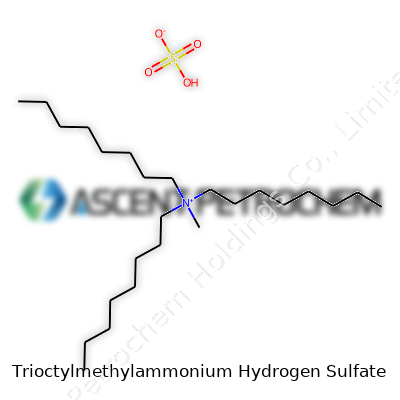
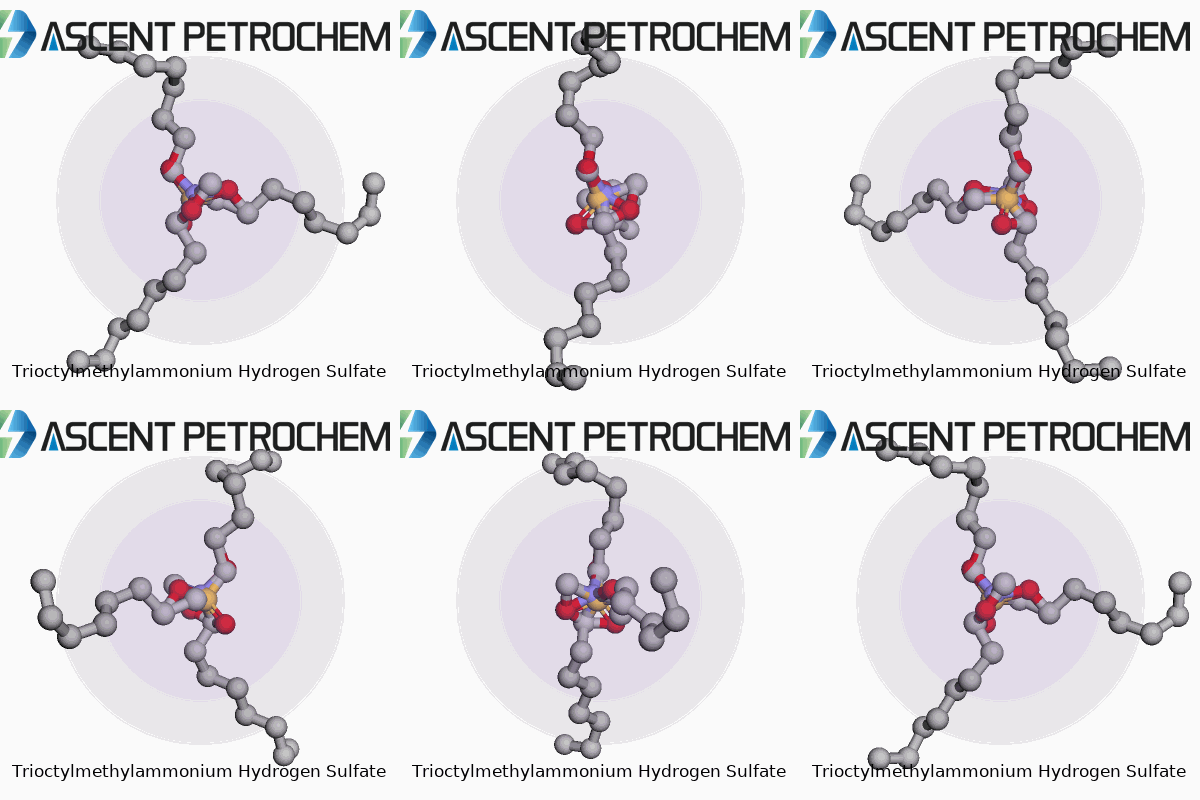
Trioctylmethylammonium hydrogen sulfate packs a mouthful of a name, but its structure breaks down in a way that makes real-world sense. Think of this compound as a combination of two main pieces. The cation side—the trioctylmethylammonium part—carries a core structure where a nitrogen atom bonds with three octyl groups (each an eight-carbon tail) plus one methyl group (just one carbon). That gives the cation an obvious bulkiness and makes it quite oily or hydrophobic. Its chemical formula: [(C8H17)3CH3N]+.
The anion side—the hydrogen sulfate portion—comes straight from sulfuric acid. It's written as HSO4−. When these two partner up, they form Trioctylmethylammonium hydrogen sulfate: [(C8H17)3CH3N]+ HSO4−.
I’ve spent enough time in the lab to spot a pattern: bulky ammonium ions like this don’t dissolve in water as readily as something small, say ammonium chloride. Those long octyl tails cause the molecule to behave differently—think more oil than salt, and this gives it properties that appeal to engineers and chemists working on tricky separation and extraction tasks. You won’t find this in a kitchen pantry, but it’s exactly the kind of chemistry you bump into in industries trying to extract metals from ores or clean up chemical spills. The hydrophobic tails let it play the part of a phase transfer catalyst, whisking ions across the border of water and oil. Sulfate’s presence adds bite, swinging pH levels or grabbing onto positively charged species during these chemical exchanges.
There’s a hazard here: specialty chemicals like this call for respect. Trioctylmethylammonium hydrogen sulfate, with its heavy hydrocarbon content, doesn’t break down in the environment quickly. Once it’s out there, it tends to linger, especially if disposal gets sloppy. Researchers and plant managers have to look for protocols that account for the compound’s stubbornness. If you dump this stuff and let it run wild, it can foul up waterways and harm aquatic life, since those hydrocarbon chains don’t play nice with wildlife.
Regulation steps in at this crossroad. Responsible handling means setting up systems to reclaim or neutralize what gets used. Modern chemistry leans on closed systems, solvent recapture, and targeted waste treatment to rein in risks. Used in a thoughtfully designed setup, this compound helps drive efficient, cost-effective separations. The lab bench and the shop floor both improve when there’s a sharp focus on life-cycle management.
People creating new extraction methods or catalysts have started tinkering with the trioctylmethylammonium structure. Some push for shorter alkyl chains to give better biodegradability, or tweak the counterion to match specific metal separation needs. Academic labs and chemical companies alike run tests for greener solvents, pressing for the same performance, only with less impact. The challenge rolls on—the more we understand the nuts and bolts of these structures, the smarter and safer our next generation of chemical tools becomes.
The moment I started working in a university chemical laboratory, someone handed me a bottle of trioctylmethylammonium hydrogen sulfate. Back then, this long name meant little. After some research, the reality kicked in: strong surfactants and ionic liquids deserve respect. This compound supports phase transfer catalysis in synthesis, so it often goes hand in hand with industrial and research-grade solvents.
Lab safety culture starts with basic habits. A chemical like this contains a large, greasy organic cation mixed with hydrogen sulfate, which tends to make it both slippery and potentially corrosive. One study in the Journal of Industrial Chemistry describes skin irritation risks, so even a small accident may lead to long-term discomfort. Mishandling might not just spoil a batch, but also threaten health and facility safety.
My professor always insisted on labelling, and with good reason. Unmarked containers invite errors, so a clear, robust label with the full name and hazard information saves time and prevents confusion. Color-coding, used in our department, makes quick decisions easier during emergencies. Beyond the label, the container material matters. Trioctylmethylammonium hydrogen sulfate often comes in high-density polyethylene (HDPE) bottles. Glass sometimes reacts with acidic residues, but polyethylene and polypropylene resist corrosion better. Nobody likes a sticky, corroded shelf or the smell of decomposing chemicals mixing in the storage closet.
Humidity and heat shorten shelf life and degrade chemical structure. Storing this compound in a cool, dry place prevents clumping or changes in texture. In my old lab, desiccators helped protect sensitive bottles from moisture in the air. A locked chemical cabinet, away from direct sunlight, keeps heat at bay. A friend once stored a bottle next to a window; UV exposure led to a mess when the compound broke down unexpectedly. Regular monitoring on a shared inventory chart avoids situations like that.
Incompatibility causes more accidents than many realize. Sulfates often react with strong bases and oxidizers. During chemical safety audits, inspectors flagged shelves where incompatible compounds sat together. Separating trioctylmethylammonium hydrogen sulfate from alkali and strong oxidizing agents eliminated risk in our lab. On the spill response front, an absorbent mat lined every shelf. PPE such as gloves and splash goggles stopped minor exposures. Clean-up kits in visible, accessible spots allowed fast action during any incident. Simple habits like keeping area uncluttered or storing only small, necessary quantities nearby prevented spills from turning into crises.
Old samples become liabilities. We followed a quarterly audit cycle, getting rid of expired materials through certified waste handlers. Logging all movements in and out of storage kept our group accountable. These steps came from hard-won experience—one overlooked bottle from a previous group almost ended up contaminating another experiment. Responsible disposal protects both people and the environment.
Safety means building solid habits around storage from day one. Transparent protocols and straightforward solutions—labels, compatible containers, climate control, sensible segregation, and clear records—remove uncertainty from the handling of trioctylmethylammonium hydrogen sulfate. Every story behind a mistake ended up teaching the next group of researchers something new about respect for even the most “routine” bottle on the shelf.
Factories and labs often chase after ingredients that make processes smoother, cheaper, or cleaner. Trioctylmethylammonium hydrogen sulfate, though a mouthful, delivers where it counts. This compound doesn’t belong on a high school chemistry shelf—it usually turns up in places where people run tight processes or wring every drop of value from raw materials.
Medicine makers are always on the lookout for ways to pull drugs from messy reaction soups. This chemical gets a regular spot in those labs for one main reason: it’s great for liquid-liquid extractions. Some drugs want to hide inside oily layers. With this compound around, the pull becomes stronger, so the desired ingredient hops into a new phase easier. I’ve heard technicians praise these “phase transfer catalysts” because they can cut both steps and solvents, hitting cost and waste hard.
Quality and purity mean everything in medicine. Trioctylmethylammonium hydrogen sulfate deals well with picky organic molecules and water-hating materials. This brings more yield with less fuss. Instead of relying on high-energy reactions, drug makers can often operate under milder conditions, sparing energy and increasing worker safety.
Oil companies aren't shy about squeezing every bit of value from crude and other feeds. This compound steps in during the extraction, separation, and purification processes. In some tough jobs, like separating metals from oil or removing sulfur, it shows a knack for boosting selectivity. Refineries count on such helpers to meet strict emission rules without breaking the bank. Removing unwanted stuff faster means less downtime and tighter control over fuel quality.
People working in specialty chemicals, including dyes and advanced polymers, often wrestle with hard-to-move molecules. Trioctylmethylammonium hydrogen sulfate acts as a “phase-transfer catalyst” again, pushing ions from water to organic solvents in reactions that normally stall. In the paint and coatings world, for example, creating better adhesion or new shades often needs this chemical touch. From personal experience, small tweaks in chemical routes can change the consistency or longevity of a product, saving recalls and customer headaches later.
Green chemistry isn't some slogan. It’s real dollars saved in disposal cost and public image. Trioctylmethylammonium hydrogen sulfate lets scientists avoid toxic heavy metals or harsh conditions that can create hazardous waste. In the mid-2010s, pilot projects showed that replacing old-school ingredients with this compound kept byproduct levels down and made spent materials easier to recycle.
While the advantages draw attention, not every lab or factory has steady access to this compound at an affordable price. Supply hiccups can slow production, especially in regions without strong chemical supply chains. Firms sometimes buy in bulk, sharing inventory across plants, or signing long-term deals with suppliers.
Handling strong chemicals demands respect. Training workers in protective habits and keeping emergency gear handy matter as much as any lab achievement. As industries lean more on specialty chemicals, people should not forget the importance of basic safety—one slip with a strong ionic liquid like this can spell trouble.
Trioctylmethylammonium hydrogen sulfate isn't just another lab material. Its rise traces back to real-world problems: saving energy, cutting waste, pulling pure products from messy mixtures, and meeting ever-tougher environmental standards. The smarter we use it, and the safer we handle it, the more these industries stand to gain in the long run.