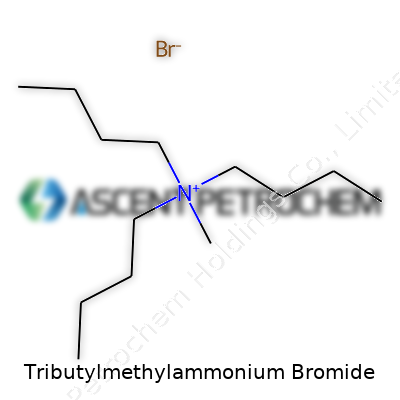
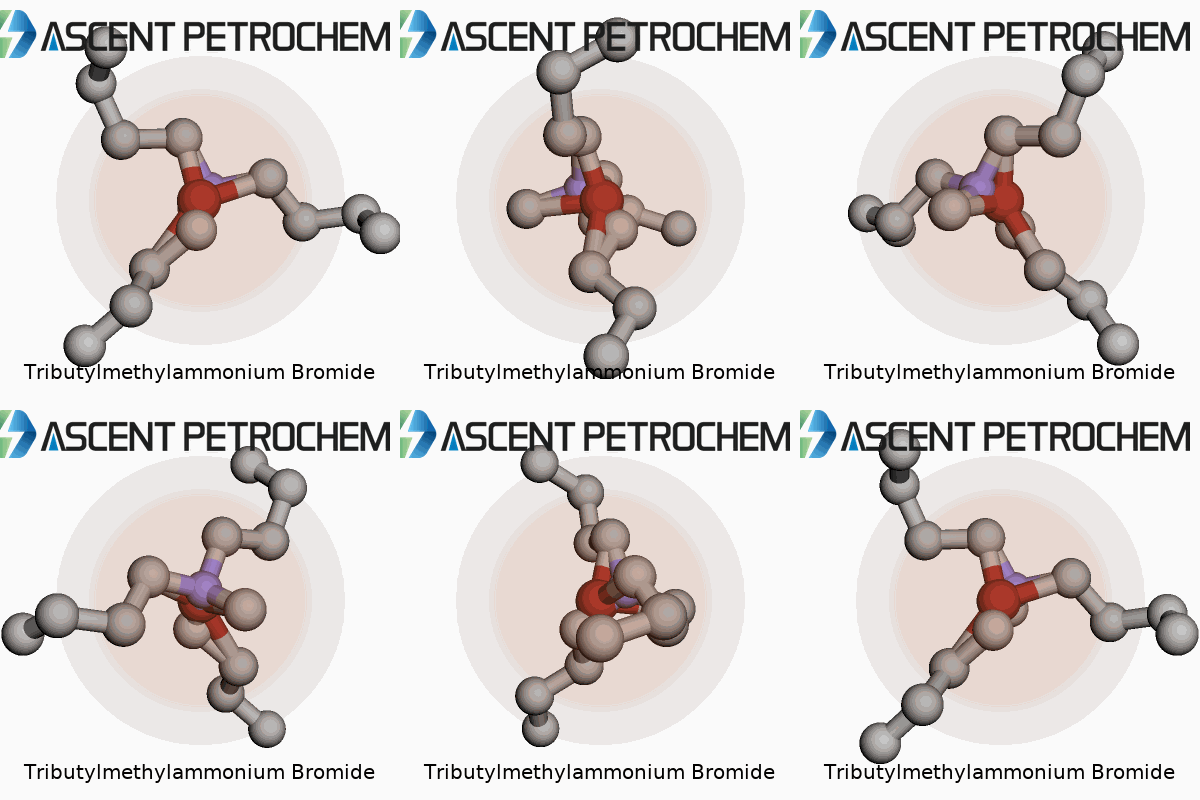
Tributylmethylammonium bromide carries a legacy dating back several decades, tracing roots to the broader field of quaternary ammonium salts. Chemists first explored these substances for their unique phase-transfer catalysis potential in organic synthesis, back when the organic chemistry toolkit looked much smaller. The rise of green chemistry in the 20th century further spotlighted ammonium salts, as they offered ways to drive difficult reactions in milder, more accessible conditions. Academic labs and industrial research centers kept uncovering new transformative uses, reinforcing demand for safer, more reliable and scalable preparations. The growth of ionic liquid technology in the 2000s saw renewed attention, with the scientific community recognizing these materials as versatile facilitators in both academic research and chemical manufacturing. Personal experience in university labs shows this compound turning up each semester, especially in coursework focused on extraction and catalysis experiments.
Tributylmethylammonium bromide usually appears as a white crystalline solid, with a chemical structure featuring a quaternary ammonium ion paired with a bromide anion. This gives it strong ionic characteristics and helps it dissolve in polar solvents like water and many organic media. Commercially, it lands on the market in high-purity grades aimed at researchers and industrial chemists who need dependable reagents. Synonyms and alternate names you might see on catalogues include N,N,N-Tributyl-N-methylammonium bromide or TBMAB. Clients in contract synthesis shops and university stockrooms recognize these names right away, signaling its importance in staple laboratory processes.
Density, melting point, and solubility stand out as key features. TBMAB tends to melt at temperatures above 95°C and boasts noticeable stability under typical laboratory and process conditions. Its molecular weight, clocking in just under 300 g/mol, makes it easy to handle in weighing protocols. Unlike some quaternary ammonium salts, TBMAB offers a manageable vapor pressure profile and low volatility, making open-bench work less of a hassle for chemists. Chemically, it combines robustness with reactivity—its ionic nature pairs well with a wide array of substrates, and researchers value the compound for its resistance to hydrolysis and oxidative degradation under standard storage.
Quality suppliers provide TBMAB with detailed Certificates of Analysis, listing purity (frequently higher than 99%) alongside trace metal and moisture content. Containers bear GHS-compliant labels outlining chemical identity, risk phrases, and handling instructions. Chemists often pay close attention to batch-specific data sheets detailing spectroscopic fingerprints (such as NMR and IR), helping avoid surprises during setups. Labs with ISO or GMP certification expect traceability, so the combination of proper labeling and technical data keeps workflows compliant and reassures regulatory inspectors.
Lab-scale syntheses typically start with tributylamine and methyl bromide in an organic solvent, allowing their well-known alkylation reaction to go to completion. This method produces the desired quaternary ammonium salt, followed up by isolation and repeated washing to eliminate unreacted starting materials. Sometimes, process chemists use closed reactor systems to control methyl bromide release, as this reagent poses safety and environmental risks. Scaling these reactions translates to more robust containment, active scrubbing, and detailed emissions monitoring—standards that chemical engineers and regulatory bodies consider essential for occupational health.
The main story of TBMAB in synthesis circles points to phase-transfer catalysis. Its ionic character lets polar and nonpolar reactants meet in a single system, driving organic reactions that would otherwise stall or yield poor conversions. Its affinity for diverse ionic and organic partners enables innovative work in nucleophilic substitutions, alkylations, and oxidations. Colleagues have successfully modulated this compound to form room-temperature ionic liquids by exchanging the bromide for other anions—a trick that expands the toolbox for solvent-free syntheses and novel separation technologies.
Beyond the classic IUPAC-style naming, it turns up as TBMAB, methyltributylammonium bromide, or N,N,N-tributyl-N-methylammonium bromide in supplier catalogs. Each name reflects a slightly different user audience—regulatory submissions rely on formal nomenclature, while bench chemists rely on brevity and tradition. This patchwork of names sometimes creates confusion, so robust cross-referencing in documentation saves time, money, and plenty of frustration across supply chains.
Safety always comes first, especially when handling quaternary ammonium salts in bulk. TBMAB does not tend to pose acute health hazards at low concentrations, but direct contact or inhalation deserves respect. Protective gear, effective fume hoods, and ready access to materials safety data sheets all form the backbone of safe lab operations. On an organizational level, compliance teams lean on routine risk assessments, chemical hygiene plans, and real-time spill response protocols. Waste disposal policies require careful attention since bromide-containing effluents risk harming aquatic systems and raising regulatory eyebrows.
From organic synthesis to industrial catalysis, TBMAB holds value for a sweeping range of sectors. Perhaps most notably, it cuts down barriers in biphasic reaction systems, providing chemists with a bridge across water-organic interfaces. At the plant scale, it helps drive large-volume reactions in agrochemical and pharmaceutical manufacturing, where time and yield matter most. Research labs have grown fond of TBMAB for experiments aiming to simplify workup and purification steps, reducing overall solvent usage and supporting green chemistry protocols. Environmental engineers explore its promise in extraction of inorganic ions and waste stream remediation, networks branching far beyond the confines of traditional chemistry.
Innovation keeps shaping the trajectory of TBMAB. Over the last decade, interest has shifted toward harnessing it in emerging fields like electrochemistry, ionic liquid synthesis, and separation science. Academic teams seek to better understand the interplay between molecular structure and phase behavior, fueling efforts to design “smart” quaternary salts—ones that pack even more selectivity and environmental resilience. On the industrial front, pharmaceutical process chemists keep searching for greener alternatives and milder regulatory settings, while contract manufacturers balance compliance with cost and sustainability metrics.
Personal experience shows most researchers respect the precautionary principle—treating TBMAB with the same care reserved for other amphiphilic surfactant substances. Animal studies and environmental screenings reveal moderate toxicity in aquatic organisms, driving calls for tighter effluent controls and advanced treatment technology. Human exposure usually shows mild skin and respiratory irritation, though chronic effects require further study. Regulatory agencies publish evolving guidelines, challenging users to keep pace with safety data, risk mitigation strategies, and transparent communication on usage and disposal.
The next decade will likely push TBMAB along several intertwined paths. Growing demand for sustainable chemical processes means the industry will keep investing in more efficient and less hazardous phase-transfer techniques. R&D teams in green chemistry want quaternary ammonium sites fine-tuned for recyclability and lower toxic impact, while academic groups pursue fundamental studies aimed at unlocking new catalysts. Regulatory momentum will not slow, so suppliers and users both must align with data-driven safety standards, robust documentation and life-cycle assessments. Approaches integrating cradle-to-grave thinking, real-time environmental monitoring, and digital supply chain tracking will accelerate, ensuring TBMAB remains relevant in a marketplace steering toward responsibility and transparency.
Tributylmethylammonium bromide, often found on chemical supply shelves as TBMAB, operates quietly behind the scenes in labs. On the surface, it blends in with similar white crystalline powders. Dig a little deeper, and you will see researchers reaching for it to help bridge two chemical worlds: water-based and organic solvents. This compound, a so-called "phase-transfer catalyst," opens up reactions that just do not happen easily otherwise. In the real world, these reactions lead to products used in everything from new medicines to specialty polymers.
I have watched colleagues spend hours coaxing polar and nonpolar chemicals to react. Pouring water into one beaker and an oily chemical into another, they hope something useful might happen. Often, the results disappoint. This is where TBMAB steps up. By sitting at the interface, it shuttles ions across boundaries, making stubborn chemicals behave. Organic synthesis teams lean on it to clean up reaction routes or cut down on toxic byproducts. In one case, a friend's research group used TBMAB to speed up the production of a pain medication. Before that, the process took twice as long with much lower yield.
Every lab purchase comes with a cost-benefit discussion. TBMAB is no exception. The compound cuts out some harsh reaction conditions, doing more with less waste. By reducing side reactions, it means less energy and fewer toxic solvents get tossed at the end. Still, any time you handle quaternary ammonium salts, safety matters. TBMAB can cause irritation if it touches your skin or gets airborne. Personal experience: one small spill led to a full clean-up and a stern reminder in the lab safety meeting.
Despite its benefits, TBMAB remains a specialty item, largely due to its price and handling requirements. Some researchers stick to old-fashioned methods using cheaper ingredients. For large-scale production, costs should drop, and safer handling guidelines help, but some companies worry about regulatory issues as well. The chemical industry faces growing scrutiny for environmental impact, so improving the sustainability of phase-transfer catalysts like TBMAB stays on the docket.
Chemists like to joke that we are only as good as our toolkit. Tributylmethylammonium bromide makes some reactions possible that would never work otherwise. Cleaner drug synthesis, better textiles, more efficient plastics—these all come back to basic building blocks. Today, green chemistry standards ask companies and research labs to shrink their environmental footprints. A compound like TBMAB can help if used wisely and disposed of responsibly.
The trick lies in education and access. Newer chemists picking up advanced techniques learn about TBMAB’s strengths and its trade-offs. Strong support from chemical suppliers, clearer safety data, and a commitment to safer lab cultures all matter. The next time you see a breakthrough in materials or medicine, chances are some obscure-sounding helper like Tributylmethylammonium bromide played an invisible yet crucial part.
Tributylmethylammonium bromide isn’t a household name, but it pops up in many labs. As a quaternary ammonium compound, it’s used in organic synthesis, particularly in phase-transfer catalysis. On paper, tributylmethylammonium bromide doesn’t sound worrisome. In practice, working with it has its quirks and hazards. Chemists like me have learned to double-check the safety sheet before grabbing the bottle.
This chemical doesn’t just sit on a shelf without risks. Even a small amount can irritate the skin and eyes. Spilling it means your skin starts to feel a burning itch, which is your first clue to wash it off. Inhalation might not happen often in a ventilated lab, though accidents aren’t rare. Breathing the dust or powder brings coughing or a sore throat, and swallowing the compound can upset the stomach. There’s no joy in guessing symptoms if someone gets exposed.
Lab workers wear gloves and eye protection for a reason. I’ve seen colleagues with mild burns from not using enough protection. This compound makes it clear that basic safety gear isn’t an option. If tributylmethylammonium bromide lands on your clothes, it lingers, leaving an odd odor and a little burning sensation. Emergency showers and eyewash stations matter more than some may imagine.
Everyone talks about lab safety, but environmental hazards deserve just as much attention. Once this chemical reaches water or soil, it doesn’t disappear quickly. Quaternary ammonium salts can harm aquatic life. I’ve joined routine clean-ups for minor spills, mainly out of respect for the creatures downstream from the lab’s drainpipe. Companies who ignore these responsibilities find themselves dealing with environmental agencies and fines. It makes sense: pollutants that persist aren’t just a hazard today—they stick around to cause more problems tomorrow.
Accidents often come from cutting corners. I’ve seen labs run short on gloves or masks, treating protective gear like an afterthought. Strict chemical labeling, clean handling, and regular training go a long way. Spill kits stand in the corner for a reason—they don’t help anyone if still shrink-wrapped after a year. Good ventilation, proper disposal techniques, and regular safety meetings make sure the dangers become more of an awareness than a reality.
While tributylmethylammonium bromide poses hazards, it remains crucial in research and industry. Cottoning on to risks helps reduce unexpected trips to the emergency shower or calls to the poison control center. Direct, honest communication about safety and environmental protection changes the daily experience in any lab. No one chooses a chemical like this for fun, but strict respect for its power keeps results reliable—and people unharmed.
Tributylmethylammonium bromide doesn’t often make headlines, but this compound has earned a secure spot in labs and industry. Scientists who work with ionic liquids and phase-transfer catalysts bump into it all the time. Its chemical formula, C13H30BrN, tells a story about the balance of carbons, hydrogens, and that all-important bromide anion. Each piece in that formula isn’t just a letter and number—it represents years of tinkering to create compounds that open up new pathways in chemistry.
Experience in organic synthesis shows that not all salts act the same. If you grab the wrong ammonium bromide, your reaction might fail, your solvent might not mix, or your experiment’s yield drops to embarrassing levels. That formula—C13H30BrN—brings predictability. You know you’re working with a molecule built from three butyl groups, one methyl group stuck to a nitrogen, paired with bromide. It’s a detail, but it cuts down wasted time.
A chemist who’s spent hours separating oil and water mixes would love the way tributylmethylammonium bromide acts as a phase-transfer catalyst. Its structure, shown by the formula, means it can shuttle charged ions across barriers—a trick that makes some stubborn reactions finally cooperate. This isn’t a minor matter for pharmaceutical research or materials science, both hungry for reliable catalytic shortcuts.
There’s plenty of evidence in open literature for the use of quaternary ammonium salts like this one. Peer-reviewed studies going back decades highlight their reliability for alkylation, esterification, and even waste treatment. Real-world case studies point to improvements in yield and safety. The specifics of the formula tie directly to these outcomes—the size and shape of the molecule change how easily it dissolves or moves ions, compared to smaller cousins like tetramethylammonium bromide.
Knowledge of the exact formula helps organizations manage safety risks. Quaternary ammonium salts can be toxic or irritating, so staff need to track which substance is in play and how much. Chemical management software pulls that formula from a database to set handling precautions or alert you if something goes wrong. Nobody likes a mystery ingredient near their workspace.
Still, not all reactions hit their targets, no matter how precise the formula. Lab teams need better ways to handle or recycle these salts. Environmental groups urge chemists to keep an eye on waste streams—brominated compounds can lead to regulatory headaches. Green chemistry programs push for protocols that use less, recover more, and test alternatives with less environmental baggage. Making informed swaps starts with knowing each atom that goes into industrial processes.
Solutions work best when people understand the details behind simple formulas. In my work, a little extra time spent with a chemical database—verifying a name, a molecular structure, a CAS number—prevents costly mistakes later. Getting to know tributylmethylammonium bromide by its formula doesn’t just help reactions run; it keeps people safer in the lab, and it slashes the odds of sending unwanted molecules into the environment.
Anyone who’s spent time working with chemicals knows that storage choices directly shape both safety and product quality. Tributylmethylammonium bromide isn’t the sort of thing you stash wherever there’s space. This compound, a quaternary ammonium salt, sees use in labs and industry. Missteps here won’t just create waste—they open doors to accidents and loss of reputation.
Years in the lab teach a person that not all chemicals behave. This one attracts water from the air. Leave a jar open, watch clumping and weird consistency changes creep in before you hit lunch. We lost a whole batch once to careless sealing. Since then, any container sits tight with a screw cap, tucked away from room humidity.
Good habits keep this salt stable. I keep every bottle well sealed in screw-top, chemical-resistant containers—plastic holds up well, though glass serves just as well for dry storage.
Moisture acts like a thief over time. We used to store jars beside the sink until someone pointed out a few grams had fused together. That low-grade mistake cost hours. Now, the compound stays in a dry cabinet, away from lab sinks or doors. Dry desiccators work even better, and silica gel packs in the container give some backup defense.
Keep this stuff away from acids and oxidizers. In shared workspaces, acids and bases often line the same shelves for quick access. That shortcut adds risk. One benchmate had a spill after storing this ammonium compound too near peroxide bottles. Cross-contamination isn’t theoretical; fumes can set off unwanted reactions even in closed jars.
Heat speeds up decomposition. A spot at the back of a climate-controlled storeroom suits this chemical. Don’t toss it on top of a fridge or near a radiator, even for what feels like a short stop. Chemicals never forgive shortcuts.
Everyone benefits when every container carries a clear label, even if the solution seems obvious in the moment. Illegible scrawl or peeled-off stickers leave colleagues guessing. Make it easy for anyone walking into storage to identify the substance and see the hazard class. Our team switched to standardized, laminated labels. Less confusion, fewer accidents.
Old, poorly stored Tributylmethylammonium bromide becomes a disposal headache. Crusts and clumps resist easy weighing or transfer. More than once, I’ve seen entire bottles tossed before their time because someone ignored good storage practice. Ask the budget manager how that feels.
For disposal, treat it like other halide salts, but check your workplace's approach—rules differ between research centers and industrial plants. Never pour it down the drain, and never mix unknowns in the same container. Trained staff and clear records make the disposal process work smoother.
Keep each chemical’s Material Safety Data Sheet handy, right in the storage area, not hidden in an office folder. Everyone working near these compounds deserves easy access to handling and storage tips. Up-to-date training helps new staff make sense of signage and storage zones.
A lab’s overall safety record reflects choices made with each container. If you respect the limits of these chemicals—watch moisture, stick to tight caps, keep them away from heat and reactive neighbors—you cut down on accidents, save money, and build trust across the team.
Tributylmethylammonium bromide looks like an off-white to pale yellow crystalline powder. It’s not flashy – no shimmer, no wild colors – just a subtle, straightforward compound that often comes as a lump or free-flowing solid. Run a finger through it, you find the texture is dry and slightly coarse, nothing sticky or oily about it. This matters for folks who handle it in labs or production: powders this dry rarely lead to frustrating clumps when weighing or mixing.
This compound dissolves well in polar solvents. Water handles it pretty well, creating a clear solution with a bit of stirring. Organic solvents like methanol and ethanol welcome it just as easily. Chemists count on this solubility when they need to make clean solutions for synthesis or extract specific ions during a reaction. Not every salt works so nicely in water and alcohols, so this helps explain why this compound shows up in research settings.
Tributylmethylammonium bromide has a melting point sitting around 300°C. That’s hot enough that most glassware or common plastics won’t have any trouble handling it. Samples rarely decompose before melting, a quality you want when heating reactions or drying chemicals in an oven. Heat tolerance builds trust: you’re not likely to watch your sample char, turn brown, or let off wild fumes just because you need to warm it up for a procedure.
This isn’t the sort of chemical that fills a room with a cloud of stink. There’s no strong odor to thrust upon your nose – an underappreciated advantage in crowded or busy labs. It doesn’t evaporate easily, so you won’t see it sneaking into the air while you work. This gives a sense of safety to anyone familiar with old-fashioned volatile amines or halides that used to dominate older lab shelves. Working with it usually doesn’t call for elaborate fume hoods, only basic lab ventilation and common-sense precautions.
Density hovers near 1.05 g/cm3. Not so fluffy that it floats away, not so dense it sinks like a stone. Scooping it with a spatula feels pretty average, so you won’t end up over or under-weighing much. This comes up often in teaching labs, especially with students learning the ropes: standard handling means fewer mix-ups and friendlier troubleshooting.
Tributylmethylammonium bromide earns points for shelf life. The solid keeps its structure for years if capped tightly and kept away from wet environments. No need for high-cost nitrogen tanks or vacuum setups just to keep it useful. Labs in warm climates or places where storage space is tight appreciate chemicals like these: reliable, low-fuss, no ticking clock as soon as the lid comes off.
Like with most quaternary ammonium salts, a responsible hand matters. While generally regarded as stable and low-risk, skin contact shouldn’t happen daily. A move toward more detailed labeling and clear handling protocols helps even busy teams stay safe. Renewable packaging or biodegradable alternatives could reduce the long-term environmental impact, something that’s overdue in small lab chemicals. People sometimes ignore these details until a spill or accident grabs attention. Putting a little more emphasis on education and transparency doesn’t hurt anyone – and often makes chemistry feel less intimidating to newcomers.