If you trace the history of quaternary ammonium compounds, the road leads back to the late 19th century. Chemists dug into organic synthesis, looking for stable cations with versatile reactivity. Tetramethylammonium iodide (TMAI) turned out to be a reliable choice, especially after methods matured for making it in high purity. The adoption picked up in the mid-20th century, as research began to focus on phase-transfer catalysts and solubilizing agents. Since then, TMAI hasn't disappeared from labs or industry, finding a home both in classic textbook reactions and in cutting-edge modern chemistry.
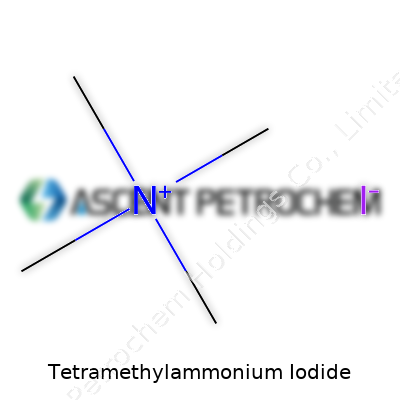
TMAI shows up as a crystalline, white solid, giving the impression of something simple but packed with utility. In my own bench work, TMAI was often used in organic synthesis, especially for reactions needing methyl donors or phase transfer properties. Its formula, (CH3)4NI, tells you you’re working with four methyl groups locked onto a nitrogen, balanced with an iodide anion. That structure sets up strong solubility in polar solvents, especially water and alcohols, making it user-friendly in many procedures.
TMAI doesn't hide its identity: crystalline, with a melting point around 230 °C, and it dissolves quickly in water and methanol. The odor, if you can detect any, comes off faint and slightly fishy, but it doesn't linger like some other iodides. Its high affinity for moisture requires dry storage, a point I learned fast after a clumped-up sample threw off a reaction yield. A density close to 1.7 g/cm³ at room temperature makes it easy to handle, without the volatility concerns of more troublesome organics.
Commercial sources offer TMAI in various purities, but the research grade commonly exceeds 98%. The CAS Number 636-39-3 helps with sourcing and compliance; most packaging lists grade, batch number, and exact purity. Safe handling means clear labeling for potential iodine emissions and organic amine risks. Safety Data Sheets come standard with hazard classifications, with pictograms indicating irritancy and environmental concern. I remember how important it felt to double-check the label, especially after nearly grabbing a methyl iodide sample during a time crunch.
TMAI synthesis starts with trimethylamine and methyl iodide. The reaction proceeds in a solvent like ethanol, with careful temperature control, as runaway reactions waste both reagents and time. Lab-scale prep means adding methyl iodide to an excess of trimethylamine, then letting the mixture stir, sometimes overnight. Washing and recrystallizing remove byproducts, leaving a product that stands up to purity checks through NMR or melting point verification. Purification matters since leftover unmethylated amines can break downstream reactions, as I learned troubleshooting an SN2 methylation.
The strength of TMAI pops out in classic nucleophilic substitution reactions. The tetramethylammonium ion tolerates harsh bases, setting it apart from bulkier cationic agents. TMAI delivers methyl groups or toggles between phases in biphasic mixture reactions. It has helped with methylations, deprotections, and certain Hofmann elimination procedures. The iodide ion acts as a soft nucleophile, useful in Finkelstein-like halogen exchange processes. I recall a time when substituting for tetrabutylammonium counterparts made isolation and cleanup smoother, thanks to TMAI’s lower solubility in some organic solvents.
Chemical catalogs list TMAI under several names: tetramethylazanium iodide, methylammonium iodide, or simply quaternary ammonium iodide. Brand labels often append batch codes or stock phrases—sometimes just “TMAI.” For procurement, looking up by CAS Number ensures you’re not buying a disguised or impure variant. With naming conventions overlapping, I always cross-referenced with the certificate of analysis to align with my lab’s method validation.
Working with quaternary salts means respecting both operator and environmental safety. TMAI shouldn’t be inhaled or allowed to contact skin directly. Laboratory experience reinforces the value of gloves, eye protection, and, occasionally, working inside a fume hood. Waste streams get careful documentation to keep iodide levels out of aquatic disposal. Most institutions set exposure limits, and a few researchers report that inhalation can cause respiratory discomfort. Routine safety drills in my lab kept everyone alert; nobody wants to run the risk of iodide exposure or deal with regulatory aftershocks from a waste handling error.
TMAI outperforms many alternatives in select modern synthesis steps, like phase-transfer catalysis or certain aminations. Electrochemists use it for organic redox mediators. The salt’s easy solubility supports ion-exchange studies, and pharmaceutical researchers rely on it to tweak solubility of actives in drug formulations. Another practical use comes in analytical chemistry, where TMAI’s ionic conductivity becomes an internal standard in NMR or a phase transfer agent in mixed aqueous-organic systems. I remember its use in making methylated derivatives for mass spectrometry, where other salts failed the compatibility test.
Current R&D looks at TMAI’s impact on green chemistry, especially where phase transfer catalysis replaces less sustainable reagents. Materials scientists investigate its behavior in perovskites and hybrid organic-inorganic frameworks, hoping to build more durable solar panels. Studies look into using TMAI as a safe dopant in electronic materials and as a milling aid in mechanochemical synthesis. Development cycles favor TMAI when chemists demand both ionic mobility and thermal stability—in areas ranging from battery research to complex organic transformations. In my experience, the reproducibility of results stems from reliable, well-characterized TMAI samples.
Early toxicology flagged TMAI as a mild irritant, with oral and dermal exposure causing nausea, headache, or dermatitis in sensitive individuals. Chronic exposure impacts thyroid function, likely from iodine release rather than the ammonium ion. A few animal studies suggest low acute toxicity, but long-term data on environmental persistence stays limited. My move to a safety-first lab culture came after hearing stories about cumulative exposure impacts—protective barriers and clear procedures always made more sense after reading these reports. Some guidelines now call for substitution with less hazardous salts in disposable, single-step syntheses.
TMAI may look humble, but the chemical toolbox keeps expanding. Researchers explore its use in more energy-efficient catalytic cycles, improved electronic devices, and cleaner synthetic routes. Regulatory agencies push for clearer guidelines around iodide emissions, which increases tracking and transparency for anyone using TMAI at scale. Green chemistry initiatives favor TMAI or derivatives as replacements for heavier, more persistent quats. Over the next decade, as battery tech and organic electronics develop, market demand for high-purity TMAI will likely grow. Real progress, from my perspective, will depend on developing recyclable forms and minimizing toxic byproducts in industrial settings.
Tetramethylammonium iodide, often called TMAI among chemists, grabs attention for its role in research and chemical production. TMAI goes beyond just being a salt with a complicated name. Its structure—four methyl groups hugging a central nitrogen, paired with iodide—gives it unique abilities in both organic and inorganic chemistry. No flashy traits scream out at first glance, but behind the scenes, TMAI changes how entire reactions unfold.
Chemistry doesn’t move forward without the right tools. TMAI offers chemists a nudge in the right direction, letting them swap atoms more easily. In the lab, TMAI stands out as a phase transfer catalyst. In plain language, it helps get stubborn chemicals to work together in the same beaker, even if they normally behave like oil and water. I’ve watched a sluggish reaction suddenly speed up just by stirring in some TMAI, because it handled the dirty work in the background.
Beyond its role as a catalyst, TMAI provides a gentle, reliable source of iodide ions in syntheses. Pharmaceutical labs chase new medicines with hundreds of steps. A single swap for a more reliable iodide source can knock days off these projects and save money—fatigue and missed deadlines follow when researchers fumble with inconsistent reagents.
In materials science, every contaminant or impurity in a chemical can change the way high-tech products turn out. Take the world of perovskite solar cells, which rely on purity at the chemical level. TMAI’s straightforward makeup and stability let companies aim for consistency batch after batch. Mess up the chemistry, and solar panels or computer chips start losing efficiency or failing early—a situation no one wants, and too much uncertainty for high-wage workers with schedules pinned to target dates.
As much as TMAI promises in the lab, handling any chemical in bulk brings headaches if safety steps get skipped. TMAI’s toxicity deserves respect, especially in facilities with young workers or people new to chemical production. Inhalation risks and skin contact both matter, so anyone opening a new drum of this chemical needs gloves, goggles, and the right knowledge. My past time in a pilot plant hammered home that no shortcut with personal protection pays off in the long run.
Disposal brings another layer. Standard sink drains don’t cut it for TMAI solutions. Responsible companies follow local environmental rules, sending spent TMAI to licensed waste handlers. This costs more up front, but avoids fines and cleanup headaches later. Sharing shortcuts in small circles can seem tempting, but the risk boomerangs back with tighter regulations—and the bad press nobody wants in their news feed.
TMAI isn’t the only answer for every reaction, but finding alternatives runs into trade-offs. Other methylammonium salts can step in, but that often means tweaking reaction conditions and risking unpredictable results. Green chemistry plays a growing role, nudging the field toward safer, less toxic choices when performance allows. In research teams I’ve worked with, adopting less hazardous salts takes work, from months of pilot testing to double-checking that yield and product purity still meet the mark. Rather than a single magic fix, change tends to creep in—a few trials at a time, backed by real results.
Tetramethylammonium iodide might not make headlines, but it quietly greases the gears in pharmaceutical, electronics, and materials labs worldwide. Its role shows how simple chemicals, properly handled, form the backbone of the progress driving modern life.
Tetramethylammonium iodide often comes up in labs that need strong yet manageable organic salts. Its chemical formula is (CH3)4NI, sometimes written as C4H12NI. Four methyl groups (CH3–) wrap around a nitrogen atom, forming a positive tetramethylammonium ion, which then pairs off with a hefty iodide ion. These details might sound textbook, but this salt keeps researchers coming back because it pushes some boundaries in organic synthesis and materials development.
I remember years ago being puzzled by why some salts acted so much more aggressive—or gentle—in simple tasks like crystallizations or cleanups. Understanding a compound’s formula tells half the story. The arrangement, the atoms involved, even the size of the ions, all shape whether something blends easily into water, how it holds together with partners, or how deeply it drives chemical reactions. Tetramethylammonium iodide fits in because it's less bulky than many other organic salts. That gives it an edge in making certain reactions run cleaner, or products separate with less fuss.
In the lab, tetramethylammonium iodide acts as a phase transfer catalyst. Think of it as a matchmaker, helping water-soluble molecules cozy up to oily organic ones. This ability saves time and cuts down on the need for extra solvents or steps. Experts have used it to guide methylation, assist in the formation of complex compounds, and clean up extraction processes. According to recent research, this family of salts even plays a part in separating rare earth metals and in high-performance batteries, thanks to its wide electrochemical window and structural stability.
It might sound like tetramethylammonium iodide is a dream chemical, but handling it brings up some clear concerns. Like many quaternary ammonium salts, it can be toxic. A whiff of dust or careless contact adds up fast in a crowded workspace. Safety data sheets always list strict precautions—a lesson that sticks when working long shifts among folks who might skip gloves or ignore ventilation. Good labeling, real training, and accessible safety gear change habits for the better. Labs that keep up with these basics tend to see fewer mishaps.
The chemical formula tells us much about behavior and risk. Some teams have switched to greener alternatives, like less aggressive quaternary ammonium salts with biodegradable chains. Sustainable chemistry remains a moving target. Sometimes there’s just no real replacement yet for benefits offered by tetramethylammonium iodide, especially in precise analytical work or emerging fields like perovskite solar cell research. But the search for safer drop-in substitutes keeps rolling, nudged along by better environmental awareness.
Working with named salts like tetramethylammonium iodide highlights the importance of more than just a formula. Getting hands-on with (CH3)4NI taught me that chemical shorthand never tells the whole story. Experience, curiosity, and a willingness to adapt safeguard both innovation and health. Chemistry demands both respect and continual learning—qualities that keep science grounded and progress real.
Tetramethylammonium iodide, or TMAI, shows up in research labs, chemical manufacturing, and even some specialty syntheses. On paper, it’s a salt made by mixing tetramethylammonium with iodide. In lab work, it often acts as a phase-transfer catalyst. The chemical formula doesn’t look scary at first glance, but toxicity rarely hides in giant molecules. Sometimes, it’s the simplest substances that bring the most risk.
Reading about TMAI’s toxicology pulls from both the stories shared by chemists and hard data, though most people outside of science circles haven’t heard any warnings. Safety Data Sheets (SDS) from reputable suppliers consistently flag TMAI as harmful if swallowed, irritating to skin, and hazardous to eyes. Internal exposure can cause symptoms such as nausea and headaches. At higher doses, laboratory animals have shown nerve damage, seizures, and even fatal respiratory effects.
Some folks figure all white crystalline powders are similar, or maybe safe if their names aren’t famous. TMAI doesn’t have the reputation of something like cyanide, but nobody wants this stuff spilled on their skin or splashed in their eyes. Studies on related tetramethylammonium compounds reveal that the cation part—tetramethylammonium—is the reason behind neurotoxic effects. It disrupts neurotransmission by mimicking compounds that naturally interact with our nerve cells. TMAI shares that cation, so it makes sense to expect similar risks.
Back in my own research days, I saw young chemists underestimate less famous chemicals. Gloves and closed shoes would sit forgotten by the back of the hood. One small spill led to hours of eye-washing and missed experiments for a lab partner—nobody forgets that lesson. For TMAI in particular, industry guidelines point toward full protective gear, with access to proper ventilation, and a focus on preventing skin or eye contact. Direct inhalation and accidental ingestion present the real dangers; TMAI doesn’t belong on bare hands or near your face.
Disposing of TMAI also raises concerns. It should never go down the drain. Some disposal companies classify it as hazardous waste since it can pollute water sources, causing harm to aquatic organisms. Ignoring protocols for disposal can also invite regulatory trouble, especially with agencies like OSHA and the EPA tightening standards for lab safety and waste handling.
Research needs chemicals that carry risk, but risk doesn’t excuse ignorance. TMAI isn’t the most hazardous compound found in labs, yet it commands respect. Anyone expecting to use it should look up all relevant material safety guidance, not just old textbook entries or quick online articles. Training, routine hazard assessments, and ready-to-use emergency procedures mean fewer accidents and healthier teams.
Schools and workplaces often teach chemical safety once, but routine drills and reality checks keep the knowledge fresh. Supporting teams with personal protective equipment and updated spill kits signals that health matters more than the speed of results. Institutions can help by keeping clean, well-ventilated lab space, recognizing that air quality matters just as much as clean benches.
Some labs now search for substitute chemicals that carry less risk or rely on micro-scale setups to keep exposure tiny. Innovative training tools—virtual reality scenarios, hands-on workshops, even real-life testimonials—make safety protocols more memorable. Funding research into green chemistry doesn't just look good on paper; it can cut down on both accidents and costly waste disposal.
Tetramethylammonium iodide reminds us that hazard wears many faces, not just bright orange warning signs. Staying cautious isn’t paranoia. It’s how anyone in the business of chemistry gets to work again tomorrow.
Managing chemicals in a lab setting relies on details and habit, not just protocols written on some safety sheet. For Tetramethylammonium Iodide, taking a relaxed approach can spell trouble for people, projects, and pocketbooks. This salt, with its white, crystalline look, feels innocuous at first glance. Reality often hits when humidity creeps in, or when containers sit near sunlight. Through a few hard-earned experiences, and by learning from others’ mistakes, a simple truth surfaces: most chemical accidents stem from storage shortcuts and forgetfulness. Chemical reliability means consistent results, clean data, and fewer emergencies.
I remember the first time a bottle of this compound clumped up—almost like sugar left open in a humid kitchen. Tetramethylammonium Iodide absorbs moisture from the air, turning from crisp powder to sticky mess in no time. That change isn’t just unsightly; it signals changes in concentration and purity. Labs pin their results on exact measurements, yet moisture, light, and air degrade the compound’s performance. Chemical purity isn’t just a preference; it's a cornerstone of any honest experiment.
Some mistakes sting harder than others. Leaving Tetramethylammonium Iodide near a window or loose-topped on the bench once forced a project restart for me. Keeping this compound in a tightly sealed, labeled bottle does more than enforce order—it stops contamination and clumping. Picking a container made of amber glass works best, as light speeds up the breakdown process and increases risk of volatile byproducts. Thermoplastic screw-top jars offer some defense, but glass does a better job against gradual chemical leakage. Never underestimate a clean, dry spatula, since traces from old samples or other chemicals compromise the whole stash.
Humidity detection isn’t as intuitive as you might think. Labs without dehumidifiers lure in disaster in wet climates. A dry, cool space staves off risk, and chemical refrigerators set below 8°C typically help. That said, putting Tetramethylammonium Iodide in deep cold can give people a false sense of security. Regularly checking seals and watching for frost buildup on jars keeps surprises at bay. Silica gel packets in storage cabinets make a big difference, cheaply protecting expensive stock.
Even seasoned chemists slip up. A rigid safety culture—one that expects double-checking, immediate cleanup, and honest reporting—builds trust over time. Every label, every logbook entry, gives future colleagues a fighting chance against sudden mishaps. Sharing detailed mistakes and lessons openly, not hushed up out of embarrassment, helps create better solutions. Nurturing these habits beats any top-down rulebook. In the end, storing compounds like Tetramethylammonium Iodide earns its importance because one overlooked jar can derail months of work. Keep things dry, dark, and organized, and you’ll find chemical headaches fade quickly into the background.
Lab routines shaped by experience—not just paperwork—turn rules into muscle memory. Tetramethylammonium Iodide, like so many chemicals, behaves best in the hands of those who take time to understand its quirks. Expect the unexpected, keep things tightly sealed, keep humidity low, and you will sidestep most disasters. Taking pride in careful storage shows respect for science, colleagues, and everyone’s safety.
Tetramethylammonium iodide often appears in chemistry labs and industry catalogs, but people outside those circles rarely give it a second thought. This compound has a molecular weight of about 185.07 grams per mole. That number comes from adding up the atomic weights: carbon, hydrogen, nitrogen, and iodine. To break it down, you combine the tetramethylammonium part (N(CH3)4+) at 74.15 g/mol with iodine at 126.90 g/mol. All together, it's 201.05 g/mol, but subtracting for different isotope references sometimes gives a slightly different count. Laboratories rely on the widely accepted value of 185.07 g/mol, based on normal isotopic abundances and recent recalculations.
Ask any chemist who has ever sat hunched over a balance with unsteady hands: weighing out a salt with a high iodine content takes practice. Heavy atoms tip the scale fast. The molecular weight might sound like trivia from a high school textbook, but it shapes how scientists prepare solutions, design experiments, and even ship chemicals across state lines. If the number is off, the math for molar concentrations skews, and entire experiments get tossed. That wastes time, money, and cuts into reliability. In drug discovery or material science, a few milligrams too many can cloud results.
Tetramethylammonium iodide isn’t a kitchen spice. Even tiny measuring errors raise safety questions. Its toxic nature and the reactivity of its ions demand care. Chemists depend on the certainty of the molecular weight to dose their reagents correctly and maintain safe practices. There’s no “close enough” in this environment. Accurate molecular weights also mean fewer allergic reactions, less unexpected byproducts, and safe disposal. One misstep ends up on the incident log, and the integrity of the laboratory drops a notch.
In my own university work, drying crystals of this salt for a synthesis challenged patience. Static electricity and humidity easily turned a clean glass vial into a mess, and the strong iodine content demanded precise ventilation. Finding a trustworthy source for the compound's molecular weight was crucial. Not every online materials database matched, and the differences caused confusion among graduate students. Fact-checking trusted sources like the CRC Handbook or Sigma-Aldrich’s catalog made all the difference. The wrong value means someone overpays for shipping hazardous material and underestimates the toxicity in waste management plans. Open-data initiatives, peer-reviewed chemical databases, and tighter regulations on labeling accuracy all add up to safer and more reliable science.
Sometimes, chemistry looks like number soup—countless formulas, weights, and constants flood the lab manual. The molecular weight of tetramethylammonium iodide stands out not just as another detail but as a foundation for lots of work that follows. Keeping these facts straight ensures every lab and industrial process can move forward with confidence. Transparency in reporting, community verification, and keeping educational resources up to date matter just as much as any breakthrough or invention. With the right numbers on hand, fewer accidents happen, progress keeps rolling, and trust in chemical science stays solid.