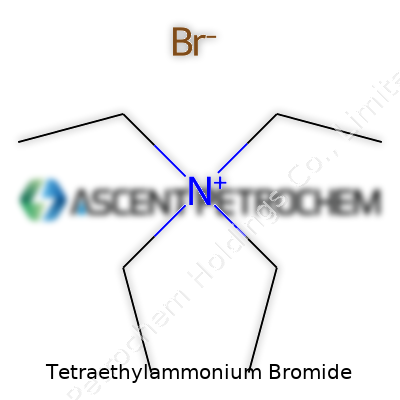
Looking back at early research moments, Tetraethylammonium Bromide didn’t storm onto the scene with the drama of some discoveries, but it quietly carved out a real place in labs around the world. Early 20th-century chemists explored quaternary ammonium compounds, finding that swapping out various alkyl groups left a lasting mark on chemical and physical properties. Tetraethylammonium Bromide soon captured the attention of scientists piecing together the secrets of nerve signals and membrane channels. Its crystallography, first pieced together decades ago, kept researchers busy refining preparation and purification steps. Even though Nobel prizes didn’t come calling, the compound became a nerve-blocking workhorse, essential for untangling mysteries in the lab.
Plenty of people pass by Tetraethylammonium Bromide in the catalogs of chemical suppliers without knowing what it actually does. On the shelf, you see its white, crystalline form, a hallmark of many quaternary ammonium salts. It shows up in sealed bottles with labels warning about ingestion or inhalation. It's easy to overlook its impact, but those who’ve handled it in electrophysiology know its power to stop specific potassium channels in their tracks. Getting reliable TEAB means checking lot numbers and grade, with researchers asking suppliers about unusual impurities so nothing gets in the way of vital results. The compound also brings structure to phase transfers—serious workhorses for industrial chemists, not just curious academics.
If you pick up a technical sheet, you’ll find TEAB listed as a stable, non-hygroscopic salt with a melting point around 288 °C. It dissolves well in water and polar organic solvents, so most folks in a lab learn to respect its ease of preparation and cleanup. The molecule packs four ethyl groups around a central nitrogen, creating a positive charge that draws in the bromide anion. For those using TEAB in reactions, its physical stability across a broad range of temperatures keeps things predictable. This means no sudden hiccups with contaminant water or breakdown during a thermal ramp. Recovering product after synthesis? Crystals come out looking pure, provided you handle solutions with patience and care.
Regulatory guidelines cover purity specifications, pushing labs and manufacturers to supply TEAB in grades that range from research-only to pharmaceutical-ready. It’s not just about white powder in a bottle. Regulatory agencies ask for minimum assay values—usually over 99%—and demand limits on heavy metals and related substances. For anyone shipping or handling it, labeling covers not just the name, but also any known hazards. Safety data sheets keep everyone honest, flagging risks with clear symbols and mandatory statements. If you ever had to prepare a chemical inventory report or a product release form, you know how strict these standards run, especially when audits loom from regulatory bodies.
Lab-made TEAB comes from quaternization. Many of us remember that childhood moment in organic synthesis where educational books paired triethylamine with an ethyl bromide. The reaction proceeds smoothly in solvents like ethanol or acetone, yielding TEAB almost quantitatively. Once you have crude product, a few steps—solvent evaporation, recrystallization, and drying—leave you with a pure, solid product. Industrial-scale makers streamline the same protocol, using reactors instead of flasks and running purification columns full tilt. Cleanup gets tricky, as byproducts and starting materials may hide in the product. Sharp TLC skills keep things clean, reminding anyone who’s slogged through purification how touchy quaternary ammonium chemistry gets after scale-up.
TEAB rarely gets used as the star player in a standard reaction, but its structure lets it step in as a phase-transfer catalyst or electrolyte. In organic synthesis, it helps ferry ions from watery to oily layers, making reactions tick that would otherwise crawl. Those working with cell biology have explored modifications: swapping the bromide ion for others, or changing the alkyl groups to shift activity. Generations of graduate students have analyzed its reactivity—testing limits with heat and solvents, looking for instability but finding TEAB mostly stands firm. This resilience explains why researchers often prefer it over less robust ammonium compounds.
Names in chemistry carry baggage, and TEAB proves this point. It can go by tetraethylazanium bromide, TEAB, or even some trade names used by older suppliers. I’ve seen confusion in lab notebooks where the wrong synonym led to a misordered chemical, causing days of delay while replacements shipped in. Reliable databases stick to the IUPAC naming—tetraethylammonium bromide. But many catalogs simplify things, so keeping CAS numbers handy—71-91-0 for TEAB—helps cut through the confusion and stops expensive ordering mistakes.
Handling TEAB demands respect—not from fear, but because subtle risks pile up over time. It won’t explode or catch fire under normal handling, but ingestion and inhalation bring toxicity. Regulatory agencies like OSHA and GHS classify it, making sure good lab practices limit risk. Gloves, goggles, and fume hoods usually cover the basics. My own time teaching undergraduate labs hammered home the importance of following the MSDS; someone always showed up trying to improvise safety, until TEAB dust made them rethink their approach. Disposal raises questions, since bromides build up in water supplies without proper waste streams. Routine audits force labs to track quantities, so accidental exposure hardly ever slips through the cracks.
Use cases for TEAB span a strange mix of disciplines. Neuroscientists first pushed its profile, blocking potassium channels to study axon behavior and signaling. Later, it wound its way into analytical chemistry, carrying ions in electrochemical cells with surety. Industrial syntheses sometimes sneak it in as a phase transfer catalyst, helping oil-soluble and water-soluble reactants meet. I’ve met chemists working in plastics, who harness TEAB to modify polymerization, creating smoother, more uniform products without wild temperature swings. In battery technology circles, TEAB forms the backbone of non-aqueous electrolytes—people tinker with salt concentration to tune voltage stability, pointing toward next-generation supercapacitors.
Current research rarely stands still. TEAB reached the core of ion channel research in the 1950s and 1960s, but today’s R&D explores it even further, testing new modifications and delivery mechanisms in pharmacology. Labs look for ways to cut toxicity, lengthen shelf life, and design new compounds that mimic or expand TEAB’s role. Biophysical studies stick with TEAB for selectivity in ion transport, while materials researchers want novel derivatives with tweaked thermal and electrochemical properties. Workshops and technical sessions echo with debates over which substituents work best, showing that the field still hums with excitement, not nostalgia.
Toxicity keeps TEAB’s reputation in check. Early animal studies found lethal doses not far from the handling range in labs, leading regulatory agencies to draw clear lines for safe use. Chronic exposure studies point to neurological and cardiovascular effects—distant relatives of the symptoms TEAB helped to illuminate in physiological experiments. Modern toxicology keeps close tabs on exposure and environmental fate. Researchers working on alternatives explore ways to lower bioaccumulation and improve post-use decomposition. Discussions on green chemistry now push for biodegradable quaternary ammonium salts, but TEAB still holds its ground due to its track record and relatively simple disposal routes when proper rules get followed.
TEAB likely won’t disappear from chemical catalogs any time soon. Battery researchers chase better ionic conductors, hoping TEAB’s backbone can inspire improvements. Neurophysiology still leans on its channel-blocking reliability, even while computational models grow sharper. Environmental advocates and chemists alike keep one eye on safety, calling for derivatives that match—or beat—TEAB on every count, not just performance. The next wave of research stands ready to either topple or reinforce the case for TEAB. But for all the talk about new materials and green chemistry, decades of practical bench work show that solid results matter most. TEAB has anchored too many protocols for too long to vanish without a proper replacement. Exploring beyond the boundaries of its original applications, the compound keeps earning its spot through steady, reliable performance in real hands-on work.
Tetraethylammonium bromide often lands on the shelves in university labs, but the story doesn’t end with shelf life. Some see a plain white powder; others see a useful tool that helps scientists pull apart the mystery of how cells work. Its main gig shows up in the study of ion channels—those microscopic gates that tell nerves and muscles when to fire. Without its help, much of what we know about how neurons carry signals would still be just a guess. Researchers use it to block certain potassium channels in nerves, making this chemical a key player in the search for answers in both medicine and basic biology.
Back in college, I spent too many late nights with patch clamp equipment and tiny electrodes. My advisor tossed around the name tetraethylammonium bromide like it was salt and pepper. He knew the stuff could help us separate out the electrical signals in nerve cells. With the chemical, we could single out what potassium was doing while leaving everything else alone. That trick made the experiments a whole lot cleaner, and the results spoke loud and clear.
Beyond the classroom, this compound also pops up in drug research. Some teams are looking for ways to influence nerve signaling in diseases like epilepsy, where the signals get mixed up and start to short-circuit. By blocking potassium channels, researchers can study what happens when the “off switch” in a neuron is taken away. Every new insight could point the way to better treatments down the road.
Its place in the lab goes further than biology. Chemists use tetraethylammonium bromide as a phase-transfer catalyst. Think of it as a kind of helper that brings two chemicals together even though they usually won’t talk to each other. That bridge opens the door for reactions that couldn’t happen otherwise, speeding up processes that save both time and money in industries from pharmaceuticals to plastics.
Some teams lean on it for making organic compounds with special structures. These structures end up as ingredients in drugs, agricultural products, or specialty materials. The chemical saves headaches for synthetic chemists who run into stubborn reactions that won’t finish without a nudge from a strong, reliable salt.
Working with any chemical asks for respect, and tetraethylammonium bromide fits that bill. Overexposure brings risks, so gloves and goggles come standard. Some newer reports raise questions about its impact if it winds up in the environment, hinting at the need for stricter protocols in disposal and handling. If labs don’t follow safety steps, accidental spills could pose health hazards for both researchers and their communities.
Solving these safety challenges doesn’t fall solely on one person. Sharing updated safety data and finding greener alternatives could shrink the risk. Many companies now invest in better training and eco-friendly practices, partly because researchers ask for it and partly because regulations tighten each year. Smaller changes, like tracking inventory and organizing storage better, keep older, riskier stocks from piling up in forgotten corners.
Tetraethylammonium bromide stands as a workhorse rather than a star player, but removing it from the picture would slow science to a crawl. Its use in neuroscience, medicinal chemistry, and industry proves its value. By treating it with care and keeping an eye out for safer options, labs can get the benefits while sidestepping preventable problems.
Tetraethylammonium bromide shows up in many chemistry labs and often catches attention because it looks harmless. People see a white, odorless powder and assume there isn’t much to worry about. I remember the first time I encountered this chemical, I spotted a small jar in the back of a fume hood. Nobody mentioned it during safety training. But reading the label, a few warnings stood out—skin and eye irritation, trouble if inhaled, and possible respiratory issues.
Experts at the National Center for Biotechnology Information and the European Chemicals Agency have studied this compound. They found that tetraethylammonium bromide can cause headache, dizziness, and nausea if handled carelessly. Direct contact tends to irritate skin and eyes. Some reports even highlight that exposure to large amounts can affect muscle and nerve function, because the chemical disrupts ion channels in cells. Almost every chemical in its class has that risk.
It’s tough to forget the stories from researchers who didn’t take gloves and goggles seriously. Lab workers sometimes felt tingling in hands or burning in their eyes after spills. I’ve seen colleagues lose track of clean handling and wind up struggling with discomfort for days. Tetraethylammonium bromide should never be handled casually, no matter how routine it seems.
This compound doesn’t just pose short-term hazards. There's growing concern about discharge into water systems. Tetraethylammonium ions resist breakdown, which raises red flags for aquatic life and microorganisms. Researchers run toxicity assays to see how it affects fish and bacteria, and the data points to some bioaccumulation and harmful changes in behavior for smaller species. Once in the water, it is very hard to remove.
I once volunteered at a wastewater plant, and remembering the struggle to filter small-molecule pollutants drives home the risk. You can’t count on municipal treatment to catch every trace. If a chemical spends longer in the ecosystem, it bumps up the chance that food webs get impacted.
No one should underestimate tetraethylammonium bromide just because it is legal and widely purchased. The proper approach boils down to personal protective equipment: wearing gloves, goggles, and never working outside a fume hood. It helps to keep the chemical in a locked cabinet, with access restricted to people who understand the risks. Spill protocols should get drilled into memory before work even begins.
Manufacturers can do more by printing clearer hazard highlights on every package. Institutions benefit from regular safety audits—taking time to check that everyone still respects the dangers, instead of letting rules get relaxed after a few years incident-free. Teaching practical chemistry isn’t only about reactions or yields; it must include strong guidance about chemical handling.
Better waste management in labs matters, too. Closed-system disposal makes a real difference. Small steps, like keeping waste containers tightly sealed or neutralizing solutions before disposal, shrink risks for everyone else down the line. In the past, old habits sent a lot more raw chemicals down the drain than most institutions would admit.
Working around potentially hazardous substances has shaped my view on lab safety. Tetraethylammonium bromide illustrates how easy it is to forget that even common chemicals can carry real risks. Nobody should be surprised by the side effects if they skip the basics. For the wider environment and anyone in the building, respect for proper handling pays off.
Tetraethylammonium bromide often turns up in laboratories and industrial settings where advances in biotechnology, chemistry, and medicine are happening. Its molecular formula is C8H20BrN, which gives it a molecular weight of 226.16 g/mol. This number isn’t just background information for chemists: it’s the anchor for calculations ranging from dose measurements in pharmaceutical development to reaction yields in synthetic chemistry. Navigating the science world means you’ve faced a moment where an inaccurate molecular weight has thrown off an entire experiment or delayed a larger project. Even a minor misunderstanding can have real repercussions.
Precision doesn’t simply mean getting a number right for the textbook. In chemistry, small errors add up quickly. Inconsistent weights lead to wasted university grants or, in the industrial world, entire batches of product getting tossed. Students in labs joke about late-night recalculations, and professionals end up running double checks when something smells fishy with their data. In pharmaceutical labs, off-target doses can affect clinical trial outcomes or patient safety. Just this year, a researcher at my local university spent weeks tracking down an error that boiled down to a rounding mistake in a molecular weight table.
This dependence on accuracy means chemists reach for trusted references. Industry-standard databases, like PubChem or the Merck Index, don’t just give the numbers—they back them up with years of vetting. The figure of 226.16 g/mol for tetraethylammonium bromide isn’t an offhand estimate. It's been verified by analysts who cross-check atomic masses, purity, and isotope ratios.
Tetraethylammonium bromide has carved out a spot in scientific history, especially as a blocker of potassium channels in biological research. Researchers tinker with solutions of this salt at very specific concentrations to understand how nerves fire or how blood pressure is regulated. Preparing solutions for animal studies or cell cultures means counting out every milligram. An error in molecular weight leads to the wrong concentration, and data can’t be trusted anymore.
In manufacturing, small mistakes multiply. Processes using this compound in specialty coatings or in chemical synthesis rely on the correct molecular weight to forecast costs and yields. Any variance sends ripples through balance sheets and, on a large scale, can trigger recall procedures.
Ensuring information comes from reputable sources builds trust at every level, from students learning lab techniques to seasoned professionals leading clinical trials. Manufacturers invest in automated systems and digital scales that reference up-to-date molecular weights. Many universities require students to show their sources alongside calculations, not just accept a number from a search engine result. Publishing clear, accessible data about compounds raises the bar for reproducibility. Many labs and companies now sync their internal databases with major chemical registries to avoid outdated or misreported figures.
The lesson learned over time is that transparency and double-checking pay off. Whether handling data for academic research, pharmaceutical development, or high-volume manufacturing, accuracy in something as seemingly simple as molecular weight preserves credibility and saves both time and money.
Tetraethylammonium bromide comes up in a lot of labs. Scientists use it for nerve research, chemical analysis, and synthesis work. Each bottle, whether powdered or crystalline, carries risk if tossed on a cluttered shelf or left open. Having used the stuff myself, I remember the clear labeling and locked cabinets as non-negotiable. With toxic chemicals, you create routines to keep accidents at bay.
You want a spot at eye level, never above your head. Chemical cabinets built from metal resist corrosion and help if there's a spill or leak. I always avoid wooden shelves, because chemicals can soak into the grain and stay there. You want shelves with a lip so, if something tips, it catches.
Heat will break down many compounds, including tetraethylammonium bromide. Set up storage well away from ovens, heater vents, and direct windows. I find a well-ventilated corner does the job. Humidity pulls moisture into every jar and bottle, so running a dehumidifier pays off in busy labs or in sticky climates.
Leave no room for leaks. Glass or HDPE plastic bottles with screw tops work best for crystals or powders. Every container gets a tight-fitting lid, and a hazard label that never fades or peels. Tape and marker fail over time; chemical-resistant labels and clear symbols make it easy for anyone to spot what's inside, even across the room. If I ever saw a cracked cap or a cloud rising from the jar, that bottle went into hazardous waste.
Some compounds don't play well with others. Bromide salts can get reactive if stored near strong acids, oxidizers, or things that shed moisture. I make sure to assign a shelf just for quaternary ammonium compounds so nothing else sneaks up beside them. For extra caution, chemical organizers use color-coded bins to separate types. Less chaos means fewer surprises.
Every movement in and out of storage goes on a log that tracks dates, names, and container condition. It felt tedious at first, but after seeing a near-miss from unlabeled leftovers, the importance got real. I would inspect chemical shelves every week, double-check expiry dates, and clear out anything past its prime. Spoiled or old tetraethylammonium bromide could leak or break down, adding risk where you need none.
A fellow student once wandered in, planning to open every cabinet for a demo. He'd missed the safety briefing. That was a wake-up call to post storage rules right on the door, spell out forbidden combinations, and give everyone who walked in the rundown on what each bottle holds. Regulations from groups like OSHA aren’t red tape—they help keep people out of hospital rooms.
Poor storage can cost people their health, lead to environmental fines, and destroy research. Everyone from chemistry grad students to techs in biotech firms has a piece of the safety puzzle. Create routines, set up the right hardware, keep everything dry and cool, and teach every new team member what lives behind each lock. Doing so isn’t just compliance—it's basic respect for people who share the workspace.
For small labs or startups, invest in a lockable metal cabinet with good airflow and a thermometer. In larger research centers, integrate chemical inventory software with routine inspections. Keep a spill kit on hand, not just for bromide salts, but for anything toxic enough to ruin your day. Regularly audit your chemical list and talk with your safety officer about better ways to segregate and protect.
Safe storage for tetraethylammonium bromide boils down to habits and hardware. Organize, label, double-check, and educate. Take the time to do it right, and you save lives, money, and years of hard work.
Many spend years moving from one research bench to another. Among the rows of reagents, tetraethylammonium bromide stands out. Its wide use in electrophysiology and pharmacology sharpens the focus on safety. There’s little room for error because one careless step with organics or salts can derail not just results, but health.
Tetraethylammonium bromide comes in white powder or crystal forms. That might sound benign, but contact with eyes or skin often causes irritation. Good gloves—nitrile, not just latex—block direct contact. A lab coat saves skin, and eye protection becomes more than a box-checking exercise. In my early days, seeing a colleague splash a dilute solution and frantically rinse under the sink stuck with me. Goggles soon stopped hanging around my neck: they stayed on my face.
No one likes inhaling fine powders. During weighing or transfers, a dust mask or working under a chemical fume hood cuts the risk. Some learn this after smelling strong, bitter compounds—never a good idea. Contamination lingers: I still remember a persistent bitter taste after one unfiltered pipetting session. The lesson? Fume hoods are for more than noxious fumes—they shield from accidental inhalation and protect everyone nearby.
Tetraethylammonium bromide stores safely in tightly sealed containers, away from heat and moisture. Desiccators help, especially during humid months. Once, a half-closed reagent bottle caked up. It said much about how sloppiness in storage can waste expensive chemicals and lead to hazardous degradation. A dry, labeled space saves both money and worry.
Minor spills demand prompt cleanup using damp paper towels—not dry, which spreads dust. Waste disposal guidelines mean added steps, not red tape. There’s too much temptation to toss contaminated gloves or towels into regular trash. Years ago, a missed waste protocol led to cleanup for everyone, not just one person. Getting familiar with local safety data sheets provides both peace of mind and a written trail in emergencies.
Tetraethylammonium bromide might not scare like strong acids, but each person has a duty to those working alongside. Cross-contamination travels by shared pipettes and crowded benches. Frequent glove changes and clean workspaces keep risk low. Once, using a supposedly clean spatula led to ruined results in our cell culture lab, reminding everyone that small shortcuts have lasting impacts.
Training shapes habits. Nobody learns everything from a manual. Senior mentors share cautionary tales—stories that last longer than diagrams. Regular reminder sessions, even quick five-minute huddles before new stocks arrive, tighten the safety net. Marking containers and never guessing at contents, especially after containers move or get refilled, sets an example.
Tetraethylammonium bromide deserves respect. Each step, from wearing gloves to logging disposal, supports not just compliance but a thriving research environment. Good science values care at every step. Those habits keep everyone healthy and research thriving, one careful transfer at a time.