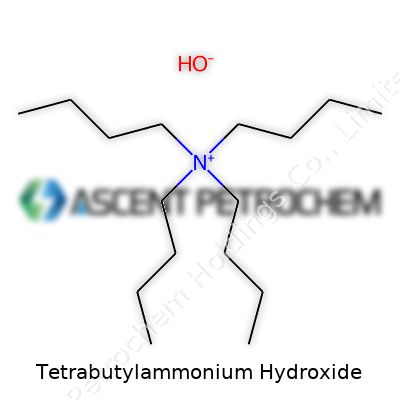
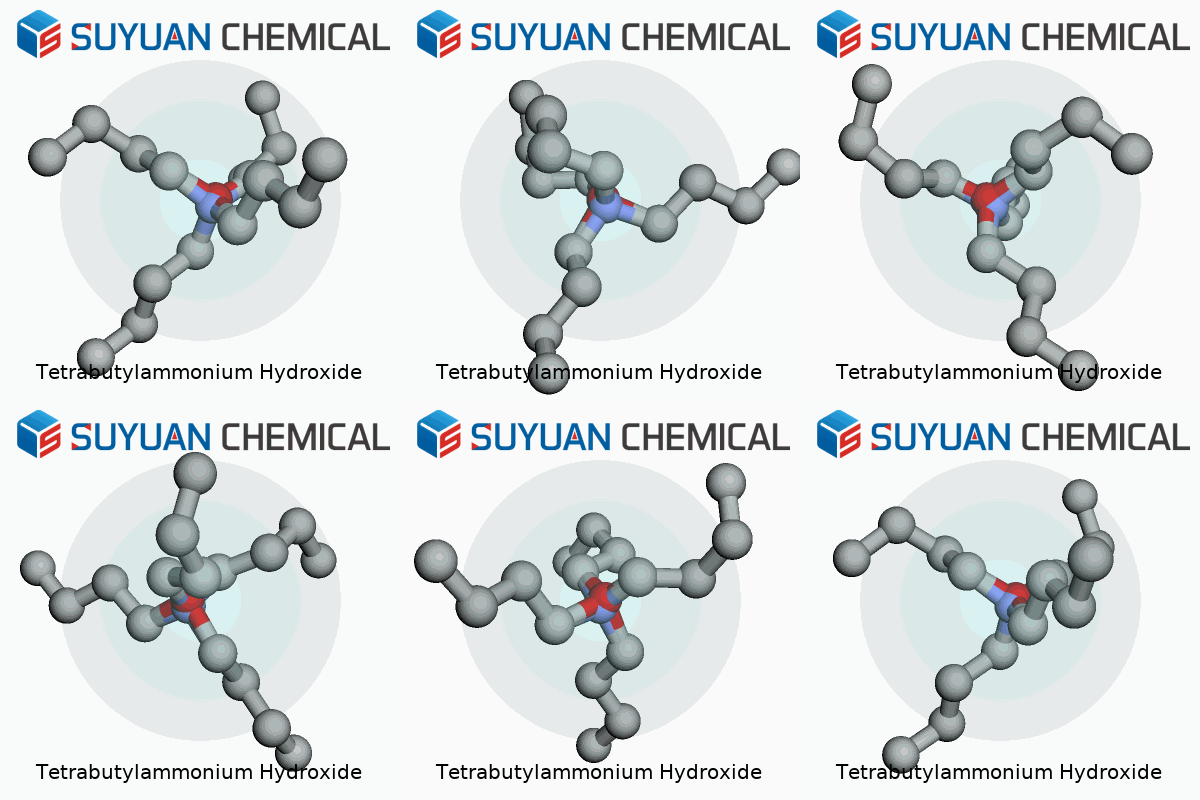
Tetrabutylammonium hydroxide grew out of a decades-long effort among chemists to replace harsh alkaline conditions with something both strong and more manageable in organic systems. Scientists first explored quaternary ammonium compounds back in the early 1900s, recognizing their strong basicity and utility in phase-transfer catalysis. Once the practical methods to synthesize and isolate large, stable quaternary ammonium ions came into play mid-century, research teams began working Tetrabutylammonium hydroxide into a range of niche syntheses, including nucleophilic substitutions and rearrangement reactions. Over time, its reputation grew thanks to its solubility in polar organic solvents and water—qualities that pulled it out of pure research labs and into production environments, electronics, and specialty chemical settings.
Chemists know Tetrabutylammonium hydroxide, often abbreviated as TBAOH, for its blend of organic and inorganic traits. Made by reacting tetrabutylammonium bromide or chloride with silver oxide in water or soluble alcohols, TBAOH comes as either a colorless to pale yellow liquid or in solid hydrates. Commercial products appear in concentrations from about 10% up to 40% in water or methanol solutions. The material earns plenty of attention thanks to its ionic nature, packing the big tetrabutylammonium cation and the small, highly reactive hydroxide anion together. That pairing lets it unlock synthetic shortcuts that sodium or potassium hydroxide simply can’t provide, especially where you need a strong base without the metal cations clouding up sensitive systems.
Looking at TBAOH, the standout properties come from its oil-like consistency, high boiling point, and complete miscibility with water and many alcohols. The tetrabutylammonium ion carries enough organic tail groups to dissolve well in both organic and aqueous environments, so you see this compound bridging phases in two-layer chemical systems. The hydroxide ion does exactly what nature intended: it’s a hungry nucleophile, eager to grab protons or attack electrophilic centers. Storing TBAOH without air-tight seals quickly leads to degradation, especially from carbon dioxide in the air, which turns it into bicarbonate or carbonate salts and drags down its reactivity.
Manufacturers offer TBAOH with clear technical boundaries: overall concentration, water content, and levels of organic and inorganic impurities all matter. Labels on commercial bottles show details like concentration in weight percent, solvent identity, and assay by titration, along with warnings about corrosivity and potential for chemical burns. In laboratories, purity determines whether TBAOH fits for analytical use or if you save it for bulk synthesis. Reliable suppliers offer certificates of analysis, affirming the absence of halides, heavy metals, or mixed tetraalkylammonium cations—details that keep unwanted side reactions at bay. Good practice includes secondary containment and using vented caps whenever possible, since its alkaline fumes burn skin and eyes on contact.
Synthesis of TBAOH, as practiced in the chemical industry, pivots on two main steps. First comes the production of tetrabutylammonium bromide or chloride, achieved by reacting tributylamine with butyl halide. Once isolated, that salt dissolves in water, and chemists pass a fresh slurry of silver oxide through it. Silver ions yank out the halide, dropping silver bromide or chloride as a precipitate, while the quaternary ammonium hydroxide stays in solution. After filtering off the insoluble silver salt, workers concentrate the aqueous TBAOH under reduced pressure, making sure not to overheat or expose it to the atmosphere—otherwise, the hydroxide picks up carbon dioxide. Industrial production focuses on yield, purity, and keeping reaction vessels free of contamination, since trace silver or halide salts could compromise later uses.
Reactivity serves as the backbone of TBAOH’s role in synthesis. Chemists choose it to deliver a strong organic base that dissolves in phases where traditional bases simply won’t go. In nucleophilic substitution reactions, TBAOH swaps out halides for functional groups like alcohols, ethers, or even cyanides. In phase-transfer catalysis, TBAOH shuttles ions from aqueous to organic layers, making transformations possible that otherwise would stall due to solubility gaps. Reactions with esters or acid chlorides see TBAOH moving things along without wrecking sensitive aromatic rings, delivering results with cleaner product profiles. Even in the world of advanced electronics, TBAOH cleans and etches, giving chip manufacturers a tool that balances aggression and selectivity—key for semiconductor surfaces loaded with delicate features.
TBAOH appears in many catalogs under slightly different names: Tetra-n-butylammonium hydroxide, tetrabutylammonium hydrate, and even its chemical formula, N(C4H9)4OH. English, German, and Japanese suppliers all list their own product codes, but the base compound remains consistent. Other labels include references to concentration and carrier solvent—such as Tetrabutylammonium hydroxide 1M in methanol, or TBAOH 40% solution. These distinctions matter when moving between academic papers and purchasing channels, so cross-referencing synonyms avoids expensive mis-orders.
Handling TBAOH calls for real focus on safety. Splashes cause severe burns, and even in dilute solutions, the compound attacks skin, eyes, and mucous membranes. Gloves made of nitrile or butyl rubber form a necessary barrier, and tight-fitting safety glasses stop caustic droplets from causing eye injuries. Fume hoods give the best protection from inhaled vapors, especially if you’re heating solutions or using large volumes on a production line. Spills respond best to absorbent material and plenty of water; some labs keep vinegar or other mild acids nearby for neutralization, though care is needed to avoid splatter. Container labeling needs to be prominent, and storage in plastic or glass works—metal reacts, producing gas and pitting the surface. Hazmat handling, secure transport, and full SDS documentation build a culture of safety that keeps operators and facilities free from accidental exposure.
Tetrabutylammonium hydroxide shows up nearly everywhere chemists stretch base-driven reactions. In organic synthesis, researchers reach for it in alkylation and the demethylation of aromatic ethers, as well as for making specialty pharmaceuticals and biochemicals. The semiconductor industry leans heavily on TBAOH as a developer for photoresists and as an etchant for silicon wafers—its residues, if any, clean off easily with water or humid air. Electrochemists count it as an electrolyte in studies of ionic conductivity, since it doesn’t corrode electrodes the way metal bases can. In analytical labs, the compound serves in titration setups where other bases would ruin sensitive detection endpoints. Industrial water treatment finds it useful for pH adjustment in situations needing a non-metallic base, sidestepping precipitation issues common with calcium or sodium hydroxide. These varied applications mean TBAOH gets factored into budgets, lab orders, and process specs everywhere the balance of strong base and organic compatibility comes into play.
Development teams regularly turn their attention to new derivatives of TBAOH, trying to tweak its solubility, basicity, and stability. Research articles over the past decade have shown how changing the butyl chains or pairing tetrabutylammonium with other anions can influence its performance in asymmetric synthesis, green chemistry, and nanomaterials. In labs pushing the limits of ionic liquid technology, TBAOH sometimes gets blended or modified for more selective catalytic cycles, driving advances in energy storage and conversion. Government and university labs focus on ways to improve the environmental profile, lower residual halides, and intensify the selectivity for pharmaceutical or agrochemical applications. From my work in synthetic R&D, the biggest breakthroughs often don’t involve raw reactivity; they grow out of incremental improvements—less decomposition, reduced byproduct formation, and a better handle on waste treatment.
Toxicologists approach TBAOH with clear eyes. The chemical causes burns, and animal studies highlight severe irritation at even moderate concentrations. Inhalation in confined spaces risks damaging the respiratory tract, and high oral doses lead to systemic effects, including metabolic acidosis and kidney damage. Environmental studies concentrate on the breakdown products; while tetrabutylammonium ions themselves tend to persist, the overall ionic strength in water systems climbs, altering aquatic environments and endangering sensitive organisms. Regulatory bodies call for TBAOH to be treated as hazardous waste, banning drains disposal above tiny thresholds except under strict treatment protocols. Workplace exposure levels stay low, and routine surveillance of air and water around storage areas picks up leaks early. Long-term, the drive for more biodegradable and lower-toxicity alternatives reflects growing pressure from environmental groups and regulatory agencies, demanding not just technical performance, but stewardship for workers and the world outside the lab gates.
Looking forward, TBAOH’s place in specialty chemistry seems secure, though the next wave of development will deepen its reach into sustainable chemistry. Clean processes, using less solvent and making less waste, turn more frequently to phase-transfer catalysts and ionic bases like TBAOH. Automated synthetic platforms harness the reagent for rapid optimization runs, producing everything from advanced materials to antiviral drug scaffolds. Electronics production engineers keep their eye on purity, seeking refinements that cut down on contaminants and broaden the use from standard chips to finer nanofabrication needs. While TBAOH itself presents challenges—especially around toxicity and persistence in the environment—future efforts hinge on recycling methods, greener production, and possibly switching to renewable feedstocks for the butyl chains. As chemical companies and academic researchers dig deeper, this long-standing base will keep shifting to meet new challenges, connecting chemistry’s past to its future.
Tetrabutylammonium hydroxide, or TBAOH, tends to show up in labs that work on both cutting-edge research and less glamorous but equally important manufacturing. Its job is to move ions around, break up molecules, and make certain chemical reactions work more smoothly. Quite a few chemists rely on it, especially in organic synthesis. The reason: it combines strong base behavior with solubility in solvents like water and alcohols. Most classic bases struggle in these conditions.
I first learned about TBAOH working in an academic lab, where stubborn molecules often refused to react with traditional bases. Swapping in TBAOH led to clear solutions and crisp reactions, often where sodium or potassium hydroxide fizzled out. I know this is not a unique experience; countless researchers have similar stories. Beyond academic curiosity, this matters for real-world tech, such as pharmaceuticals and advanced materials, where quirks in a reaction can cost weeks or months of work.
For folks tinkering with phase-transfer catalysis, TBAOH plays a central role. Picture trying to get oil and water to interact: catalysts like TBAOH act like a highly skilled translator, letting the two sides talk chemistry just long enough for the real reaction to happen. Strong base strength and ability to shuttle ions between phases lead to more efficient, cleaner reactions. This quality saves time and money, and cuts down on wasteful byproducts.
Electrochemistry labs turn to TBAOH as a supporting electrolyte. In batteries or sensors, stable and conductive solutions help electrons move. Companies building the next wave of environmental tech or medical sensors look for compounds like TBAOH that remain stable and don’t catch fire or break down under mild stress.
You’ll see TBAOH in electronics production. Take printed circuit boards: etching copper without this compound often means using older, harsher chemicals that chew through machinery and eat away at safety margins. TBAOH offers a gentler option, making cleaner lines and helping keep the workplace safer. I remember watching technicians switch to TBAOH and noticing fewer complaints about fumes and less equipment replacement.
Environmental science brings another side. Scrubbing pollutants from air or water as part of advanced oxidation processes, TBAOH steps up to catalyze and improve the breakdown of nasty chemicals. A city struggling with contaminated groundwater can see direct benefits as labs and treatment plants deploy TBAOH alongside other remediation tools. This isn’t theoretical—recent case studies point to improved efficiency in breaking down pesticides and industrial runoff.
No chemical earns universal praise. TBAOH packs a punch: strong caustic behavior means skin, eyes, and lungs need protection during use. Environmental release can cause harm in waterways, where it disrupts fragile biology. Responsible storage and careful handling matter. Facilities committed to sustainability train their people diligently and invest in closed systems to keep TBAOH where it belongs.
Safer alternatives or greener production methods take shape as more companies adopt sustainability goals and regulations tighten. Minds in academia and industry look for next-generation compounds that fill TBAOH’s role with fewer side effects. From my own experience, open communication between chemists, manufacturers, and regulators will do the most to ensure progress.
TBAOH won’t disappear soon, but the future calls for smarter applications and better stewardship. It’s a reminder that every advance in chemistry is only as valuable as our willingness to use it wisely.
A bottle of Tetrabutylammonium Hydroxide (TBAOH) never leaves my mind at ease. From what I’ve handled in the lab, its reputation as a strong organic base, typically dissolved in water or alcohol, makes it essential in organic synthesis work, especially for phase-transfer catalysis and in analytical chemistry labs. But this compound doesn’t take kindly to poor storage. I’ve seen firsthand what can happen when even a single step gets skipped — think dangerous fumes, degraded solutions, and ruined experiments.
TBAOH reacts with air and absorbs carbon dioxide and moisture faster than most chemicals. That glass bottle with a loose top after a rushed use feeds on that, forming carbonate crusts that nobody wants floating into their next batch. I’ve made a point of using airtight, chemical-resistant containers—PTFE or HDPE have both worked for me—so there’s no risk from plastic breaking down or from metal reacting.
Keep it out of sunlight. My first year as a lab assistant, someone left a solution on a sunny windowsill. A yellow-brown mess showed up a few days later, and it stank. UV light and warmth speed up degradation, so the only place I’ve stored TBAOH since is deep in a cool chemical storage room, well below 25°C.
I approach TBAOH like a jealous roommate—every drop and every lid matters. I use only clean, dry pipettes every time; even a hint of water brings surprises you don’t want, especially if you’re working with the concentrated solution. TBAOH likes to escape its container, with a vapor pressure that catches out the careless. Gloved hands, eye protection, and opening it slowly under a fume hood have served me well. A splash to bare skin burns, and the smell lingers.
Neighboring chemicals in the storage area can spell disaster. I make sure not to keep acids or oxidizers near TBAOH. One splatter in the past led to an exothermic reaction I’ll never forget—the hiss and heat are warnings you only need once.
No bottle gets put on the shelf without a label, both the date it was opened and its concentration. Rotating stock stops old material from being forgotten and turning into a mystery hazard. At my last gig, we tracked inventory on a shared spreadsheet, so nobody got caught off guard by low levels or suspicious color changes that signaled breakdown.
Once, an intern poured unused TBAOH down the sink to “clear some bench space.” What followed was a mild panic over possible pipe damage and vapors. Neutralizing with a weak acid before calling chemical waste disposal has been our go-to ever since. Environmental harm runs high with TBAOH, and discharge regulations stay strict for good reason.
Working with chemicals like Tetrabutylammonium Hydroxide reinforces how much safety depends on attention and clear rules. Good storage habits keep both people and experiments steady. Training new staff directly, leaning on clear labels, using right containers, and showing the consequences of shortcuts have done more for lab safety than a dozen policy memos. Guidance from chemical suppliers and vetted sources always shapes my choices, but experience at the bench proves the real value of proper storage.
Tetrabutylammonium hydroxide, often called TBAH, finds a spot in many chemistry labs. From organic synthesis to phase-transfer catalysis, TBAH helps reactions along, but it packs a punch in terms of risk. I've handled this compound on the bench, watched colleagues take shortcuts, and seen one too many avoidable mishaps during hurried setups. Truth is, safety with TBAH matters—not only for personal health, but also for keeping projects and teams on track.
TBAH doesn't mess around. It’s strongly corrosive, burning skin and eyes almost instantly. One careless splash can mean a trip to the hospital. Breathing the vapors or mists can irritate and even damage your lungs. Many TBAH samples come dissolved in methanol, water, or acetonitrile—all of which bring their own dangers. Methanol poisons quickly and quietly. Spilling TBAH solution on a poorly ventilated bench puts everyone at risk.
Early in my research days, an older chemist drilled this into me: Never underestimate a strong base. Before starting, glance through the SDS and talk through the procedure. I've worked with teams who skip this, only to scramble during a spill. Know where eyewashes and showers stand in the lab. Make sure they actually work—test them, don't trust the signs.
Always suit up: thick nitrile gloves, a proper lab coat, and snug safety goggles. TBAH eats through latex, so don't cut corners on glove choice. For bigger jobs or dilution steps, consider a face shield. Once, I watched a splash hit a sleeve, soak through, and leave a nasty burn. Lab prep pays off.
Any TBAH work happens in a fume hood at the bench where I work. That means sash pulled low and exhaust fans up. Never use TBAH at an open benchtop. Ventilated and marked waste containers keep spent TBAH and dirty wipes away from the trash can. At the end of the day, label every bottle clearly—confusing TBAH with anything else leads to disaster, especially during late shifts or when teams rotate.
Every chemist should review spill plans before touching a drop. Weak acid neutralizers work on small spills, but larger accidents demand a retreat and group help. If TBAH hits your skin, flush with water—don’t just wipe it off. Medical attention may sound overcautious, but caustic burns can worsen over hours, and too many people delay getting help.
The best labs talk about safety openly. I’ve learned more swapping stories about mistakes than I ever did in training slideshows. Talking through what went wrong after a close call helps everyone handle dangerous materials with more respect. People skip steps if they feel rushed or embarrassed to ask questions—breaking that pattern protects more than just today’s experiment.
Tetrabutylammonium hydroxide speeds up science, but only if it’s handled right. Training, proper gear, good ventilation, and honest conversations lay the groundwork for safe research. I’ve seen labs thrive by making safety routine and visible—no shortcuts, no excuses. That’s how you keep TBAH out of the ER and in the reaction flask, where it belongs.
Tetrabutylammonium hydroxide (TBAOH) shows up in a lot of labs, especially for organic synthesis and phase-transfer catalysis. Over the years, different chemists have told me stories about managing this quirky compound, and almost every tale circles back to shelf life. This isn’t just a matter of paperwork or following a manufacturer’s leaflet. Chemical stability matters, especially with something as sensitive as TBAOH.
TBAOH wants a specific environment to stay good. It’s usually sold as a solution, often in water or sometimes methanol. My old supervisor drilled into our heads that TBAOH won’t stick around unchanged for ages like sodium chloride. If you crack open a bottle and forget about it on a shelf over a summer, don’t expect it to act the same next semester. This is all about chemistry, not magic. Carbon dioxide in the air slowly changes TBAOH into tetrabutylammonium carbonate, and it does it faster than many people realize. Even a tightly capped bottle can’t keep all the CO₂ out forever. The bottle’s age, whether it’s glass or plastic, how high the concentration runs, and how many times people open it — these details chew away at shelf life.
Manufacturers usually mark the best-before date between 12 months and 2 years from manufacture, if you keep it closed, dry, and out of bright light. My own experience matches up: fresh TBAOH does its job well, but after even a year in storage, odd results start cropping up. Some suppliers claim longer windows, but that often assumes you keep every drop away from the open air and dip into the bottle as little as possible.
I’ve noticed visible changes in aging TBAOH solutions. They pick up a yellow tinge, maybe get a little cloudy, sometimes even form crusty deposits near the neck of the bottle. That’s your sign it’s absorbing CO₂ and breaking down. Labs running regular titrations or organic extractions can spot the difference in yields or inconsistent reaction times. A published study in “Analytica Chimica Acta” (2013) found that samples left unprotected at room temperature for six months lost over 20% of their strength. Similar results turn up across academic and industrial reports. Dipping into online forums, chemists regularly warn against using TBAOH that sat around on a bench for half a year. Rarely does anyone have a great story using old stock — often, it’s the cause of confusion or failed syntheses.
From watching how labs handle their stockroom and talking with other researchers, a few simple steps make a difference. Keep TBAOH in its original container whenever possible, away from light, and always tightly closed after use. Never pour used material back in the bottle. Use small vials or aliquots for daily work. For long-term storage, refrigeration around 4°C slows the breakdown, but don’t freeze it unless the manufacturer agrees. Fresh stocks—less than six months old—consistently give the best results for most applications. Veterinarians and academics using TBAOH in buffers for ion chromatography or extraction work have echoed this advice repeatedly.
There’s real cost hiding in wasted time and failed reactions. Taking shelf life seriously isn’t just about compliance or habit; it supports reproducible work. Skimping here can unravel months of experiments. If a “weird” result pops up, consider how old the TBAOH is before blaming technique. Reliable chemistry depends on knowing your reagents and respecting their quirks — and this one, in my experience, is worth special attention.
Tetrabutylammonium hydroxide, or TBAOH, finds its way into many labs and manufacturing sites for a reason. Its role as a strong organic base in organic synthesis, phase-transfer catalysis, and as a reagent in electronics production gives it a sort of quiet versatility. Folks usually notice that you don't just pick up any bottle—TBAOH comes in several concentrations and even a few distinct physical states, so it matters which one lands on the lab shelf.
The most common form is its liquid solution, often mixed with water or sometimes methanol. People who spend long hours prepping reaction mixtures typically reach for solutions that range from about 20% up to 40% concentrations. This is not an arbitrary detail. Lower concentrations help with tasks where gentler reactivity cuts down on side reactions. Higher percentages save space, cut shipping costs, and can push reactions forward when customers need every last bit of reactivity.
Strength does not always equal simplicity, though. Stronger solutions tend to absorb moisture and carbon dioxide from the air. This pulls down their shelf life and affects consistency from batch to batch. Anyone storing high-concentration TBAOH quickly learns to seal containers tight and keep humidity away.
There’s also a less common, but no less useful, solid form. The hydrated solid—crystals containing water molecules—lets labs weigh out exact amounts, especially where solvents in liquid preparations might interfere. In my time prepping materials for controlled studies, switching to a solid form trimmed down some variation in reaction outcomes.
Solid TBAOH keeps better, travels easier, and holds a longer shelf life, although it usually needs to be dissolved just before use. Labs without elaborate drying setups, or where storage space runs short, might see this as a key advantage.
On the industrial side, electronics manufacturers use TBAOH for photoresist stripping and etching. They may order industrial drums or tankers filled with aqueous solutions tailored to their lines—here, purity and concentration impact both product yields and worker safety. Trace impurities from packaging or storage can spiral into costly problems, causing defects or requiring shutdowns. Suppliers now spend more on traceability, matching purity grades to specific customer needs, and sharing third-party testing data.
Environmental management weighs in as well. Any hydroxide, if mismanaged, presents disposal headaches. Handling stronger concentrations means a tighter focus on safety and waste treatment. Some facilities have recently adopted closed-loop systems to recapture solvents or neutralize the waste more effectively, reducing risks and operational costs.
Every lab worker gets tempted to buy the most convenient or cheapest option, but with something as strong as TBAOH, a quick conversation about use case pays off. Double-checking the supplier's SDS, verifying purity standards, and thinking ahead about shelf life cuts down on money and time lost to failed reactions. If the goal is sensitive synthesis, solid hydrated TBAOH might serve better. If the workhorse is large-volume catalyst prep, aqueous solutions probably fit better.
Science keeps pushing for faster and cleaner solutions, and TBAOH keeps pace by showing up in whatever form the task needs. Lab techs and engineers who take a few minutes to match concentration and form to the demands of the work usually avoid the headaches and wasted effort that come from taking shortcuts.