Tetrabutylammonium fluoride trihydrate has come a long way since its early days in the late 1960s, when chemists searched for practical sources of fluoride ions that wouldn’t destroy glassware or pose excessive risks to lab workers. Early fluoride reagents were notorious for corrosiveness and stubborn solubility issues. Quaternary ammonium salts, especially the tetrabutylammonium variety, solved many of these hurdles by enabling the delivery of a “naked” fluoride ion in polar organic solvents. Over time, the hydrate form—particularly the trihydrate—became a trusted staple. Chemists relied on its predictable behavior and practical storage, with far fewer headaches than anhydrous options. The path to modern availability followed cycles of academic experimentation, commercial upscaling, and dozens of adjustments for purity and stability. Bench scientists today might not pause to consider that this material’s routine status masks a couple generations’ worth of fine-tuning by researchers who sometimes risked fingers (and lab budgets) finding a safer blend.
Tetrabutylammonium fluoride trihydrate shows up as a white to off-white crystalline solid. Sold in many lab catalogs, it often sits in amber vials on organic synthesis shelves. It dissolves in polar aprotic solvents, especially acetonitrile, and chemists reach for it to carry out transformations impossible with less reactive fluorides. Compared to the anhydrous or tetrahydrate versions, the trihydrate form hits a good balance in handling and reactivity. Shelf-stable under recommended storage conditions, it offers fluoride’s classic reactivity—removing silyl groups, introducing fluorine, or shifting equilibria that require basic work in a non-aqueous setting. The product’s reputation rests squarely on its consistency, both for routine deprotection of protecting groups and for more specialized organofluorine chemistry.
The compound’s molecular formula (C16H36FNO3) catches the eye primarily for the size of the tetrabutylammonium cation. Physically, this results in a surprisingly low melting point, generally around 60–65°C, making it easy to handle and weigh even with a standard lab scoop. The fluoride ion packs a punch, acting as a strong base and nucleophile in almost any scenario where water stays out of the way. Because the three water molecules coordinate the fluoride ion, the compound keeps its solid form under dry air, but if exposed to excess humidity or handled with wet hands, it quickly starts to cake or dissolve. A faint ammonia-like odor may drift out during uncareful handling, underscoring the need for a fume hood. The material’s solubility in DMF, DMSO, and acetonitrile remains a huge selling point, standing out in organic labs that can’t risk glass corrosion.
Labs need material with less than 0.5% impurities. Most suppliers offer analytical-grade product, clearly labeled with batch numbers, CAS number (87749-50-6), a purity specification of at least 98%, water content, and recommended storage temperature between 2–8°C. Labels mandate hazard pictograms, risk statements, and handling advice as demanded by global chemical safety authorities. Package inserts typically include a certificate of analysis, traceable to a particular synthesis run. Because the trihydrate picks up moisture quickly, suppliers ship it in tightly sealed bottles under inert atmosphere when possible. For regulatory compliance, all packages list UN numbers and transport regulations, given fluoride’s reputation as a toxic substance. Users get safety data sheets that reinforce the need for gloves, goggles, and secure chemical waste disposal.
Manufacturers typically generate tetrabutylammonium fluoride trihydrate by reacting equimolar tetrabutylammonium hydroxide with hydrofluoric acid under controlled, anhydrous conditions while constantly monitoring the water content. The resulting solution gets concentrated by rotary evaporation, then cooled to crystallize out the trihydrate as a solid. Because fluoride ions can attack almost any glass surface, synthesis happens in Teflon or high-density polyethylene vessels. Purification relies on repeated recrystallization and sometimes vacuum drying, always mindful not to overheat or overdry. Every batch gets checked with titration to confirm the fluoride content. Manufacturing scales range from kilogram specialist runs for chemical suppliers to multi-ton operations for larger life sciences firms. Safety oversight never relaxes, as HF byproducts threaten both worker safety and product purity.
Tetrabutylammonium fluoride trihydrate acts as a mild yet effective fluoride source in organic synthesis, especially for deprotecting silyl ethers to form alcohols. It works cleanly, selectively targeting silicon–oxygen bonds without attacking most other functional groups under optimized conditions. Researchers appreciate its mildness, which preserves fragile backbone structures that more aggressive acids or bases destroy. In forming carbon–fluorine bonds, it serves as both a catalyst and direct reagent. The product’s three water molecules sometimes influence reaction rates or selectivity, leading to modifications where chemists dry it further or use molecular sieves during the reaction. Emerging synthetic methods employ this reagent in nucleophilic aromatic substitution, fluorodecarboxylation, and heterocycle formation, adding to its modern value. Product innovation sometimes involves encapsulating the material in polymer beads or combining it with phase-transfer catalysts to improve reaction profiles.
Tetrabutylammonium fluoride trihydrate answers to several names: TBAF·3H2O, Tetra-n-butylammonium fluoride trihydrate, and TBFA trihydrate. Common abbreviations in the literature include TBAF and TBFA, with or without the explicit mention of the hydrate status. Different suppliers differentiate with catalog-specific numbers or slight tweaks in naming to suit regulatory or branding needs. Researchers and students should always double-check the degree of hydration before use, as confusion between trihydrate, tetrahydrate, and anhydrous forms changes reaction outcomes and safety risks significantly.
Handling this fluoride salt calls for respect and good habits. Even hydrated, the fluoride ion aggressively targets calcium in bones and soft tissues; skin contact or inhalation causes systemic toxicity. Thick gloves, goggles, and disposable lab coats serve as defense. Eye wash stations and calcium gluconate gel must be ready for emergencies. Labs train workers to clean up stray dust or spills without exposing others. Waste disposal routes separate fluoride-containing material for hazardous incineration or licensed landfill. Standard operating procedures include hydration checks before disposal—too much dry material poses inhalation risks, but excess water can cause loss of product or dangerous leaks. Good ventilation keeps workers safe. Every person working around TBAF learns to respect its hidden dangers, an experience that sticks after a few tense moments dodging errant crystals in a busy lab.
Tetrabutylammonium fluoride trihydrate dominates in organic synthesis labs for desilylations and installs fluorine atoms at precise positions on aromatic rings—key steps for pharmaceutical and agrochemical development. New drug candidates sporting fluorinated motifs often result from TBAF deprotections. Polymer chemistry takes advantage of its power to attach fluorine to backbone structures, adjusting materials’ durability, solubility, or performance in specialty coatings. Analytical chemists use TBAF to derivatize samples ahead of mass spectrometry or gas chromatography, especially for confirming the presence of alcohols or protecting groups. Environmental chemists rely on it during persistent organic pollutant analysis, liberating bound or hidden species for detection and quantification. Its reach spreads to education, where chemistry majors get hands-on experience with real-life deprotection, learning both the power and pitfalls of modern fluoride reagents.
Research teams continually look for ways to increase TBAF’s selectivity, minimize side products, and reduce worker exposure. Projects explore greener synthesis pathways starting with sustainable feedstocks and less caustic conditions. Modified forms—such as ion-pairing with bulkier cations or embedding in resin matrices—seek to reduce spill risk and simplify product recovery. Mechanistic studies probe how water of hydration affects deprotection rates and selectivity. Pharmaceutical researchers hunt for catalytic processes that use TBAF sparingly yet unlock complex organofluorine product libraries. Big chemical companies invest in continuous process flow technologies to make TBAF preparation cleaner, faster, and more consistent, while academic labs dissect its role in forming new carbon–heteroatom bonds not possible with older fluoride sources.
Workplace safety drives toxicity research, as does the increasing scrutiny that persistent organofluorine compounds face. Chronic exposure studies highlight fluoride’s risk to skeletal and neural tissue through long-term, low-level intake, even in hydrated or bound forms. Acute exposure case reports from labs reveal that symptoms—tingling, nausea, confusion—require fast treatment. Animal studies shape occupational limits, as sub-lethal doses showed disruption of mineralized tissue and kidney function. The compound's volatile history with glassware accidents underscores the value of ongoing toxicity research guiding improved personal protective equipment, better training, and tighter packaging requirements. Researchers in environmental science work to predict how TBAF waste streams might behave in landfills or water sources, partnering with analytical chemists to track breakdown rates, leaching, and natural remediation options.
The need for new fluorinated pharmaceuticals, tougher specialty polymers, and robust analytical workflows keeps interest in tetrabutylammonium fluoride trihydrate strong well into the future. Its use may expand alongside miniaturized chemistry platforms, flow chemistry, and greener, solvent-free synthetic approaches. Researchers push boundaries on catalyst loading and reusability, aiming for less waste and minimal human risk. Environmental regulations could drive the search for substitutes with lower persistence or bioaccumulation, nudging developers toward biodegradable ionic liquids or encapsulated fluoride sources. Safer packaging, built-in spill prevention, and smarter monitoring with RFID tagging may reshape industrial distribution. Toolkits for organic chemists almost certainly keep a spot for this time-tested reagent, but future generations might find themselves using more user-friendly, less hazardous, and better-targeted versions as discovery science meets real-world safety and sustainability demands.
Chemistry loves a toolbox stocked with the right reagents. Walk into any organic chemistry lab, and you’re bound to find Tetrabutylammonium Fluoride Trihydrate (TBAF·3H2O) sitting on a shelf, not because it’s trendy, but because it solves problems. One of my first introductions to serious organic chemistry involved TBAF. The professor waved a vial and said, “This unlocks your molecules.” He didn’t exaggerate. In the daily grind of the lab, TBAF lets scientists remove pesky silyl-protecting groups—temporary shields added to alcohols—far cleaner than other chemicals. If you try to skip it, you’ll end up chasing impurities for days.
Medicinal chemistry owes a quiet debt to TBAF. Drug discovery often relies on precise changes to molecules. Take away a benzyl group here, swap in a fluorine there. The role of TBAF isn’t glamorous, but without it, many life-saving drugs would be delayed or stuck in development. In my time working alongside a pharmaceutical team, our only alternative meant harsher chemicals and more waste, multiplying both costs and environmental headaches.
Materials science teams also call on TBAF for crafting complex polymers and new materials. Fluorinated compounds play a role in building plastics, coatings, and electronic components. TBAF enables chemists to introduce fluorine atoms into their molecular designs. Electronics companies in Asia developed thin, flexible screens using this strategy, blending chemistry and engineering. TBAF remained the quiet assistant delivering those strategic fluorine atoms.
Ask anyone who’s handled traditional fluoride sources. Many release toxic gases or corrode glassware, risking both safety and ruined experiments. TBAF in its trihydrate form behaves better: easy to weigh, manageable, and less prone to releasing noxious fumes. Students, new hires, or seasoned professionals—nobody wants to gamble with dangerous chemicals. In my early research years, I watched a reaction go south because another fluoride reagent etched the glass—hours wasted, lessons learned. TBAF’s reliability keeps these headaches off the calendar.
Green chemistry isn’t just a buzzword. The planet notices every solvent spilled and every hazardous byproduct tossed out. TBAF helps labs cut down on the harsh acids or heavy metals often demanded by other deprotection methods. This reduces the load on waste treatment and limits environmental harm. Regulatory bodies in Europe have nudged chemists toward greener reagents, which puts TBAF at the center of compliance and responsibility.
TBAF isn’t perfect. Mishandling can cause burns or health issues, especially if the trihydrate form dries out and releases volatile fluoride. It’s not a household cleaner. Good labs will train staff to respect PPE, containment, and disposal rules. Using just enough, storing it dry and cool, and planning regular reviews all keep risk in check.
Waste disposal creates another challenge. Local regulations vary, but many places treat fluoride waste with serious caution. University labs often work with chemical waste companies that know how to handle this safely, sparing staff from unnecessary risk. Some research teams experiment with recovery and purification, aiming to reuse the reagent and slash waste.
TBAF·3H2O won’t win any popularity contests, but smart chemists and responsible labs know it gets things done safely and cleanly. It’s paired with good training, clever engineering, and respect for safety, all adding up to breakthroughs in medicine and new technology. The next innovation might slip through the lab door, carried by something as unassuming as a vial of TBAF.
Tetrabutylammonium fluoride trihydrate doesn’t come up in everyday chat outside the chemistry crowd, but in a lab, this salt packs a punch. Used for removing protecting groups and helping out with tricky reactions, it demands respect. It’s not something that forgives shortcuts, especially if you let the storage slide.
Back during my grad school days, I saw smart people lose precious samples and good humor all because of careless storage. Keeping moisture-sensitive reagents on a cluttered bench near the sink? Everyone paid for it. Now, talk about TBAF trihydrate and moisture, and the chemists will mention its appetite for water, and how it can fall apart or even attack containers if left out.
TBAF trihydrate acts like a sponge for water, and let’s not forget the corrosive bite of fluoride ions. Exposure to open air leads to clumpy powders or, worse, degraded product. I’ve opened a bottle that was left loose, only to find a sticky, unusable mess. A single careless act can turn a hundred-dollar bottle into hazardous waste.
Best bet: tight-sealing bottles. Glass makes the grade, especially those with ground-glass stoppers or solid screw caps. Plastic with PTFE linings stands firm. Thin lids or poor seals let in more than you’d expect, and here, each drop of humidity chips away at your purity.
Labs run on budgets the size of a dime. Every waste adds up. Suppliers note that TBAF trihydrate stays stable only if kept cool and dry. Once, a colleague shrugged off guidelines, sticking TBAF near a hot vent. After a month, they complained about inconsistent reactions—until the culprit stared back from the cabinet in a brown, dampened clump.
Temperatures matter too. Shoot for under 25°C, and count on refrigerators with desiccant packs. Any colder, and the salt can absorb moisture from the air when taken back out. Desiccators aren’t just for show; they’re the line between reliable chemistry and start-from-scratch heartbreak.
Fluoride salts warn with their hazard labels—strong toxicity, risk to skin and eyes, and a need for ventilation. Forgetting to store them properly heightens these dangers. Each poorly sealed jar increases the risk of accidental exposure. I’ve seen the aftermath of a botched spill cleanup in an undergraduate lab: tears, stinging fingers, and a now-forbidden storage drawer.
Storing TBAF trihydrate right means keeping students and staff out of the health office. Wear gloves, don eye protection, and never trust plain cardboard boxes. Full chemical hygiene routines beat shortcuts every day. That means labeling all containers by date, using secondary containment, and logging usage.
Solid lab practice grows from day one, starting with respect for the quirks of sensitive reagents. TBAF trihydrate rewards those who take the extra minute to dry hands, close lids, and stick with the refrigerator rule. Throw in a checklist for storage audits, and the odds of spoiled reagents plummet.
Chemistry isn’t just about bold discoveries—it’s about the day-to-day grind that keeps people safe and results trustworthy. Safe storage, even for an unloved bottle of TBAF trihydrate, lays the ground for all the successes that follow.
Tetrabutylammonium fluoride trihydrate shows up in many labs, especially where organic chemists work on deprotecting silyl ethers or handling fluoride-driven reactions. This isn’t stuff you can treat like table salt. Breathing in its dust or fume can trigger a burning sensation in the nose or throat, and contact with bare skin causes irritation, sometimes burning, if not washed off quickly. The real punch comes if it gets into your eyes; the fluoride ion isn’t gentle. There’s a story from my own grad school days about a student who tried “just a quick weighing” without gloves, only to deal with red, tender skin for a week.
Gloves aren’t optional. Nitrile gloves work well for short tasks with tetrabutylammonium fluoride trihydrate, though heavy exposure or spills can force the need for a double layer or thicker gloves. In a pinch, switching gloves partway beats hoping the first pair held up. Always wear chemical splash goggles—one slip with a spatula or a drop escaping during transfer, and you want your eyes shielded. Lab coats should cover skin, and I practice keeping any loose sleeves out of the way since spills find the unprotected spot every time. Between each step—glove up, goggle up, and tie back hair.
Work in a fume hood. It’s easy to shrug off switching from open bench to the hood, especially when mixing small amounts, but that habit turns into regret when dried residues become airborne or reaction byproducts linger. Clean up all powder spills with damp disposable towels, and pitch them straight into a dedicated chemical waste bin—never the regular trash. Give the bench a full wipe-down after, and inspect the area: every crumb matters.
Moisture transforms tetrabutylammonium fluoride trihydrate into an even bigger headache, breaking it down and letting free fluoride ions move around. Screw-cap bottles work best, tightly closed after every use. This bottle belongs on a dedicated chemical storage shelf, marked with hazard labels and away from acids or anything that could kick off a nasty reaction. Keep water far from your workstation to stop accidental contact.
Wash skin exposed to this compound under running water for fifteen minutes—no shortcuts. Eyewash stations ought to be ready, not blocked by boxes or equipment. Seek help fast if someone gets exposed, since skin burns or eye injuries from fluoride take time to let their full damage show. Tell the supervisor and file an exposure report right away, so medical attention doesn’t get delayed.
No matter how many years you’ve spent in the lab, it only takes one distracted moment to cause a scare. Read through the chemical’s Safety Data Sheet before use, even if you’ve worked with similar compounds. Periodic hazard training keeps safety top of mind. I’ve learned from experience to never assume that the “usual” way is safe. Paying attention, running short “what if” drills, and double-checking procedures may sound basic, but these habits keep real accidents rare.
Classic methods often get swapped for safer or easier alternatives as chemistry matures. Some labs test fluoride sources that cut down on dust or lower absorption risks. Automated dispensers eliminate spills from scooping. Lobbying department heads to stock safer-handling gear—and to replace outdated containers—pushes everyone toward a higher standard. Simple conversations about a near-miss often spark better protocols, as people swap stories and sharpen expectations together.
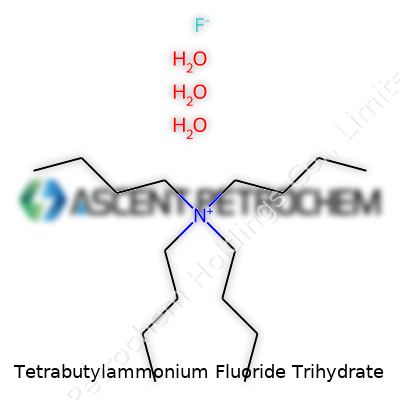
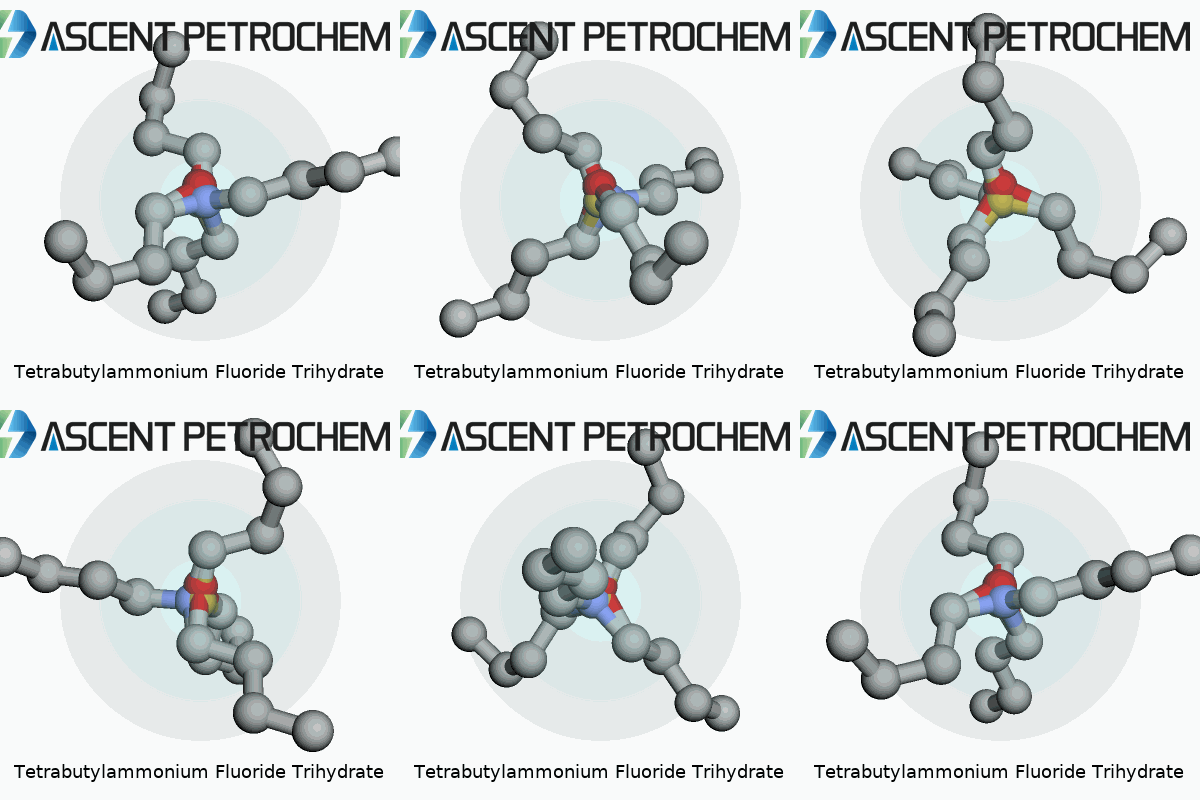
Tetrabutylammonium fluoride trihydrate often comes up in labs focused on organic synthesis. Its chemical formula is C16H36FN·3H2O. Each molecule includes a tetrabutylammonium cation (C16H36N+), a fluoride anion (F−), and three water molecules of crystallization. That adds up to a structure that’s both interesting and a little quirky—a bulky organic group attached to a small but powerful fluoride ion, cushioned by water molecules.
Diving into numbers, the molar mass gives a practical tool for planning lab work. Here’s how it stacks up:
Fluoride ions sit near the extreme in terms of reactivity compared to other halides. They are brisk, strong nucleophiles, meaning they’re eager to react in many organic transformations—deprotection of silyl ethers, for example. Tetrabutylammonium acts almost like a chaperone, carrying the fluoride into organic solvents that water avoids. The trihydrate doesn’t just hang around in the background; those water molecules help keep the solid manageable and balance the reactivity. Too little water and the compound can turn tough to handle or even degrade, releasing tiny clouds of hazardous fumes. Too much water dilutes its punch for some reactions.
Using tetrabutylammonium fluoride trihydrate brings safety into sharp focus. Years of bench work taught me not to underestimate dry fluoride salts—they are brutally corrosive and can damage glassware, skin, and eyes. The trihydrate’s water content keeps the substance less volatile, but it pays to wear gloves and goggles every single time. The inhalation risk and chemical burns pose real dangers in poorly ventilated spaces.
Anyone who’s weighed out pale, clumpy trihydrate crystals for a synthesis project has felt the need for accuracy. Water content can shift with humidity or careless storage, making your calculated molarity drift off target. Precision matters here. Analytical chemists regularly check samples by Karl Fischer titration to ensure the water content matches what’s on the label. Reliable results demand respect for the compound’s fickle nature.
Producers and end-users share the task of keeping quality high. Vendors ought to provide batch-level water-content data, not just theoretical values—my own group’s reactions suffered from sticky, old samples that sat too long on the shelf. More research into alternatives that avoid tedious handling or toxic byproducts could push the field forward. Researchers testing greener fluoride sources could save time and keep health and safety standards higher.
Tetrabutylammonium fluoride trihydrate isn’t the flashiest compound around, but understanding its formula (C16H36FN·3H2O) and molar mass (315.51 g/mol) builds confidence in the lab. Good practices, thoughtful suppliers, and honesty about limitations make this compound a staple that keeps chemical progress rolling safely.
Synthetic chemists often reach for tetrabutylammonium fluoride trihydrate—usually called TBAF trihydrate—when they need to take off a silyl protecting group. Recipes you find in journals and bench guides recommend TBAF in THF, DMF, or acetonitrile. After years of watching students and colleagues struggle with cloudy solutions or slow reactions, it’s clear that the “soluble in organic solvents” assumption doesn’t always hold up for this salt. It’s a constant source of fuss during late-night reaction set-ups.
The problem traces back to the water. That trihydrate form means TBAF lugs along three molecules of water with every ion pair. Put a scoop of the powder into dry THF, the crystals take a while to get wet and break up. Sometimes you swirl the flask and find some floating gel; not exactly the golden solution we hope for. A group from Stanford published years ago that the trihydrate dissolves slowly, and the water can create two separate pockets in the organic solution—one hydrophilic, the other hydrophobic. Mixing takes effort. Reaction rates and yields suffer when fluoride ions stick to water clusters rather than attack those silyl ethers.
Colleagues have developed workarounds: add more THF and stir longer, or warm mildly to coax the solids in. These tricks help, but plenty of grad students grumble about TBAF’s stubborn refusal to act like other quaternary ammonium salts. Nobody enjoys scraping a sticky residue from glassware after a failed dissolution.
Consider other forms of TBAF. The anhydrous salt, for example, generally brings better solubility but loves to absorb water from the air and stays tough to handle. TBAF in premade commercial solutions takes the guesswork out for many reactions, but shelf-life brings its own headaches—some vendors’ bottles degrade and lose their punch in just a few months. Researchers at MIT found that using TBAF in ionic liquids led to more consistent results, as these media blend water and organics better, letting the fluoride ion roam freely.
Solvent choice stands out as important. Not every organic solvent supports TBAF trihydrate equally. Acetonitrile and DMF do a better job picking up the salt compared to THF or DCM. Researchers experimenting with solvent mixes, or starting with a tiny bit of water to kickstart dissolving, see more reliable outcomes. In one industrial lab, the switch to acetonitrile improved workflow and shaved hours off some synthesis runs.
No chemist enjoys wasting precious time swirling a flask, hoping sticky chunks disappear by magic. Facts, not assumptions, help us set up better reactions—TBAF trihydrate needs careful handling, and picking the right solvent and salt form makes a difference in productivity and yield. The best science happens with reliable reagents. Open conversations and real data, not old habits, push the chemistry community forward.