Benzyltriethylammonium bromide entered laboratory practice more than fifty years ago. Its early development followed the path blazed by classic quaternary ammonium salts, shaped by the needs of synthetic chemists in both academic and industrial labs. Back then, folks tried to solve the problem of getting organic and inorganic compounds to talk to each other in reactions where water and oil simply would not mix. Simple phase-transfer catalysts came onto the scene. Suddenly reactions that needed harsh conditions could run milder, with more forgiving yields and fewer headaches. Researchers recognized the versatility of this type of salt—and Benzyltriethylammonium bromide carved out a reliable spot for itself in the toolkit, moving from glass flasks in chemistry departments to large-scale reactors in fine-chemical manufacturing.
Benzyltriethylammonium bromide appears as a white to off-white crystalline solid, easy to spot and easy to handle. Chemists reach for it as a phase-transfer catalyst to help shuttle reactants between layers that would otherwise stubbornly refuse to interact. This compound fights the inertia in classic two-phase systems, making reactions both faster and more complete. As someone who has handled countless quaternary ammonium salts through the years, I can tell you the granularity, the texture, and the faint whiff off the product all signal a genuinely tried-and-true synthesis aid—universally recognized, easy enough to purify, and cost-effective for labs operating on tight budgets.
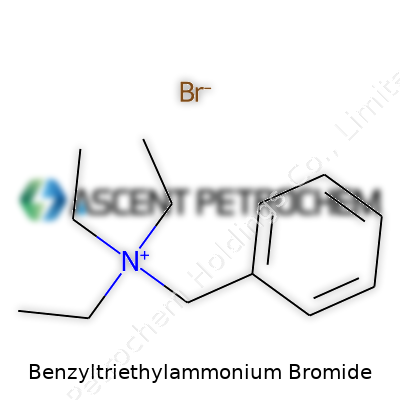
Benzyltriethylammonium bromide has the formula C13H22BrN. It typically melts between 161°C and 164°C. The molecular weight clocks in at around 288 grams per mole, putting it right in the middle range for practical phase-transfer agents. The compound dissolves readily in polar solvents—think water, methanol, ethanol, and sometimes acetonitrile—while staying put in most hydrocarbons. The clear absence of strong odor or strong color gives it an edge for monitoring reactions where colorless substrates are involved. Its structure—a quaternary ammonium center with three ethyl arms and one benzyl group—says a lot about how it works. The hydrophobic benzyl moiety helps ferry organic ions, while the charged nitrogen grabs onto ionic species in water. This duality drives its applications in phase-transfer catalysis.
Industry standards for Benzyltriethylammonium bromide focus on purity and moisture content. Typical commercial samples boast purity levels near 98%. Water content usually sits below 1.5% thanks to vacuum drying during manufacturing. Impurities like residual benzyl chloride or triethylamine rarely creep in when proper synthesis routes and distillation steps are followed. Standard labeling posts the chemical name, formula, CAS number (5197-95-5 for those keeping score), molecular weight, batch code, and expiration date—making inventory control at the bench much smoother.
This compound comes from the reaction of triethylamine with benzyl bromide. The typical synthesis runs in an organic solvent like acetonitrile or ethanol, maybe even toluene if you can handle the cleanup. Mix equimolar quantities of the reactants, gently warm, and after a few hours, white crystals start to form. Old-school chemists use vacuum filtration, wash with cold ether to strip away residual hydrocarbons, and finish drying under reduced pressure. Yield and purity depend on how carefully one controls stoichiometry and temperature—cut corners, and you risk sticky byproducts. For those chasing extra purity, a recrystallization from acetone or ethyl acetate finishes the job.
The real power of Benzyltriethylammonium bromide shows up in its catalytic activity. As a phase-transfer catalyst, it moves anions like hydroxide or cyanide from water into organic solvents, unlocking reactions that otherwise drag or stall out. Finkelstein reactions run smoother and snappier—halide exchange, for example, goes to completion under milder conditions. The quaternary ammonium group stands up to strong nucleophiles without breaking. Over the years, researchers tweaked the structure, swapping benzyl for longer or branched alkyl groups, even adjusting the counterion. Some labs prefer chloride or iodide as the counterion, depending on solubility or reactivity constraints. Yet, despite these tweaks, the original bromide variant remains a gold standard—affordable, easy to use, solid in storage, and adaptable to everything from simple alkylations to the manufacture of pharmaceuticals.
Trade catalogs and safety sheets label this compound under plenty of synonyms: Benzyltriethylammonium bromide, BTEAB, BTEA bromide, TEBA bromide, and even the more formal N-Benzyl-N,N,N-triethylammonium bromide. Researchers scanning for procurement will see these names popping up across catalogs from Sigma-Aldrich, TCI, Alfa Aesar, and other suppliers around the globe. Being familiar with these synonyms helps avoid confusion—especially for graduate students or newcomers searching through international databases or older journal literature.
Safety always takes priority. Benzyltriethylammonium bromide, though handled with bare hands by some old-timers, earns respect due to its potential for causing irritation. Skin or eye contact should be avoided—always wear gloves and goggles. Prolonged exposure can lead to mild allergic reactions in some people. Dust inhalation, while rare, may trigger respiratory discomfort. Labs should install proper ventilation, post clear labeling, and store the product in tightly closed bottles away from oxidizers or strong acids. Training newcomers on safe handling makes a difference—prevention keeps the decades-long clean-safety record intact.
This versatile reagent shows up everywhere solvents meet, but react poorly. Chemical manufacturing taps Benzyltriethylammonium bromide to transform agricultural intermediates, dyes, and fragrances with less waste. In the lab, synthetic routes that once required aggressive reflux or expensive transition metals now unfold in phases with water and oil, thanks to this catalyst. I’ve seen benchtop yields bump by 30% or more with its use, cutting hours from reaction times. Engineers scale up these reactions, integrating Benzyltriethylammonium bromide into continuous-flow processes that supply drugs, polymers, and specialty chemicals on a commercial scale. Academic groups experiment with new green-chemistry reactions, often using this salt to test new ideas for sustainability.
Ongoing research follows multiple paths. Scientists study structure-activity relationships by tinkering with the size and flexibility of the alkyl arms. Some researchers chart the effect of changing the halide ion, aiming to redefine what works best for specific transformations. Other labs explore immobilized versions—attaching the cation onto solid supports—hoping for improved recyclability and less solvent waste. The search for more sustainable, less toxic phase-transfer catalysts runs parallel to the effort to expand Benzyltriethylammonium bromide’s use in greener, water-based chemistry. In hands-on workshops, I’ve watched students test both traditional and modified versions of this catalyst, seeing firsthand which new designs survive real-world conditions and which fall flat before scale-up.
Toxicology studies on Benzyltriethylammonium bromide reveal moderate acute oral toxicity, with LD50 values in rats typically starting above 1000 mg/kg. The compound breaks down in the body relatively slowly, so chronic exposure raises more concern than a single accidental splash. Environmental risks remain limited because the salt does not easily volatilize or bioaccumulate; it tends to stick in water and soil, gradually degrading by microbial action. Workplace exposure limits have not been universally established, but prudent handling standards have kept harmful incidents sparse. Most chemists rely on standard operating protocols, controlling exposure by glove use, containment, and waste neutralization before disposal. Where regulations demand, effluent is pretreated to reduce ammonium levels—minimizing headaches downstream and ensuring regulatory compliance.
Trends in green chemistry and sustainable manufacturing suggest a steady, maybe even rising, future demand for Benzyltriethylammonium bromide. Start-ups and university teams seek low-toxicity, minimal-waste phase-transfer techniques, and this compound stays in the conversation thanks to its affordability and adaptability. Scholars continue to push modifications—tuning hydrophobicity or appending functional handles—searching for ways to make chemical manufacturing less messy and more energy efficient. In decades on the bench, I’ve seen legacy reagents fall out of favor due to regulatory shifts or innovations. Benzyltriethylammonium bromide sticks around, standing up to routine use and adapting as demands shift toward sustainability and green process chemistry.
Looking at Benzyltriethylammonium Bromide, or BTEAB, a chemist will know its worth right away. Not everyone stops to ask what jobs this compound handles, yet its reputation stretches from university labs to industrial sites. BTEAB works as a phase-transfer catalyst. In plainer language, that means it helps two chemicals that normally do not mix well — like oil and water — to react more easily. Chemists often run into trouble when reactions stall because substances stick to their own layers. With BTEAB, that struggle ends before frustration sets in.
Picture making soap, a common step in organic chemistry. Fats and sodium hydroxide, for example, do not blend directly. Drop BTEAB into the setup and it helps carry one reactant into the other’s territory. That job is a deal-breaker for many chemical syntheses. A reaction that crawls along can jump ahead just with this catalyst. Over time, many chemists have come to rely on BTEAB for processes like alkylation or nucleophilic substitution. Years back, I remember working late in an undergraduate lab, facing sluggish conversions. A senior handed me some BTEAB and, sure enough, things sped up. Watching those cloudy layers disappear brought home just how helpful the compound could be.
BTEAB’s value goes beyond student exercises. Many factories need high yields from their chemical reactions. The push for greener chemistry also means less waste and milder conditions. In the manufacture of pharmaceuticals or specialty chemicals, efficiency matters. A phase-transfer catalyst like BTEAB gets more reaction for the same amount of energy and feedstock. For instance, herbicide synthesis or drug precursor production can run cleaner and cheaper. According to industrial chemistry reports, using BTEAB can shave hours off production times and cut the use of harsh organic solvents.
Any compound with clout in a lab also comes with responsibilities. BTEAB needs careful handling, respecting both the skin and lungs. It can irritate, and there’s always the risk that spills head into water or soil. That’s part of modern chemistry’s big challenge: balancing performance with health and ecological care. Using BTEAB more wisely means training chemists to follow safe procedures and check disposal routes. Companies tracking waste streams find that tightening up storage and limiting open use drive down accidental releases.
Green chemistry teams look for even better solutions. BTEAB does the job well, but research groups experiment with new catalysts that are less persistent in the environment or easier to recycle. Some focus on biodegradable alternatives or tailor-made versions that deliver all the benefits but break down more quickly after use. Sharing know-how between academic labs and manufacturers encourages safer, more effective chemistry. As innovation grows, old standbys like BTEAB might get new competition — or form the base for the next generation of safer catalysis tools.
Benzyltriethylammonium bromide stands out with its chemical formula C13H22BrN. At its core, the molecule carries a quaternary ammonium center—one nitrogen atom linked to one benzyl group and three ethyl groups. The structure creates a positive charge on the nitrogen, balanced by a bromide anion. It works a bit like a molecular handshake between organic and inorganic worlds, letting chemicals that usually avoid each other share the same lab bench and react together.
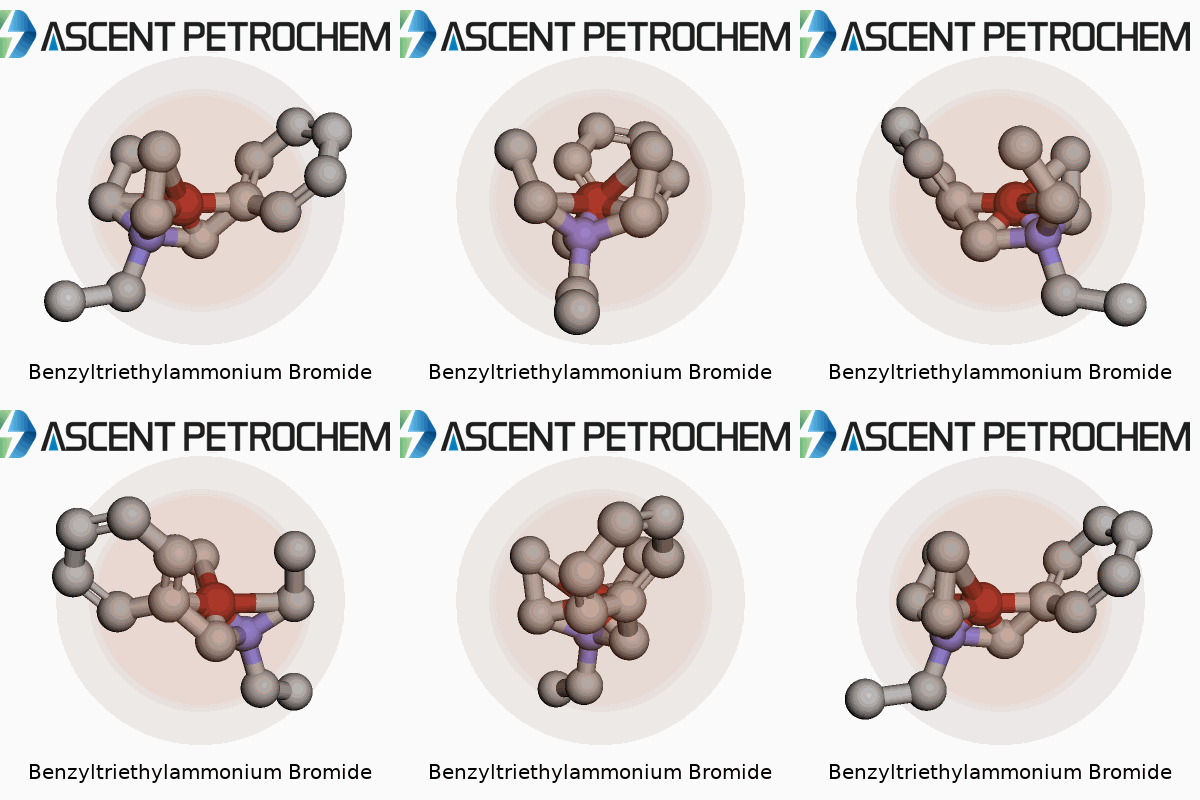
Picture this: a central nitrogen surrounded so it almost resembles a cross, with three straight ethyl chains and one more extended benzyl (a six-carbon ring with a side chain) hanging off it. The heavy bromide ion hangs out nearby, not directly attached but keeping the nitrogen electrically neutral overall. The design looks simple, but it packs practical punch.
Plenty of us never see technical chemicals in daily life, but Benzyltriethylammonium bromide works quietly in all sorts of processes. It serves as a phase-transfer catalyst. That sounds complicated, but here’s what matters: most reactions slow to a crawl if water and oil-based chemicals can’t meet. This compound helps bridge the gap by making it possible for molecules from different worlds (think water-soluble and oil-soluble) to get close and do their work. This ability plays a role in cleaner industrial methods, production of pharmaceuticals, and even the faster creation of certain plastics.
On the job, I’ve noticed chemists appreciate shortcuts that avoid harsh conditions or toxic reagents. Here’s where phase transfer catalysts shine—Benzyltriethylammonium bromide allows milder temperatures and greener chemistry. That’s good for workers, but even better for the environment.
As with most catalysts, safety tends to fly under the radar until problems pop up. Benzyltriethylammonium bromide isn’t the worst actor around, but it can still irritate skin and eyes, and if misused in large quantities, it racks up pollution risk. Many facilities now monitor waste streams more closely, recycling or treating spent catalyst before discharge. Good ventilation, gloves, and simple storage steps go a long way toward keeping workplace risks low. In my opinion, strong protocols matter more than splashy warnings—clear labeling and proper training support safe use every time.
Plenty of efforts are now aimed at swapping out traditional catalysts for versions based on renewable resources. Organic chemists have started developing biodegradable phase-transfer agents, aiming for options that leave less environmental footprint without giving up efficiency. Real progress comes from blending these safer alternatives with established best practices. Some labs join forces with local agencies for disposal and recycling, cutting down on single-use waste. Real solutions demand both strong science and boots-on-the-ground follow-through.
Benzyltriethylammonium bromide might not make headlines outside specialty papers, but its influence stretches from lab experiments to industrial-scale manufacturing. Keeping safety and sustainability front and center matches both knowledge and responsibility.
Benzyltriethylammonium bromide looks like white crystals if you catch it under the right lab lights. Its chemical formula might remind someone of organic chemistry class, but most people who use it understand this is more than a textbook reagent. This compound works well as a phase-transfer catalyst in organic synthesis, cutting reaction times and improving yields. Researchers and chemists have handled this compound for decades, which makes advice about its storage not a matter of theory but of safety—and real productivity in the lab.
Leaving chemicals like Benzyltriethylammonium bromide sitting out can lead straight into problems. This compound attracts water from the air, which people in the field call hygroscopic. If a chemical cake forms in the bottle, the catalyst may not function as expected. We lose time, money, and sometimes, by extension, the trust placed in quality research or product manufacturing. I learned my lesson early—after opening a badly stored old bottle, the mass inside clumped and refused to dissolve. The result was a day spent cleaning glassware and explaining to my team why our reaction stalled.
If you want to avoid clumps or unwanted reactions, keep Benzyltriethylammonium bromide locked away in a cool, dry spot. Room temperature usually works just fine, but the heat from nearby equipment or sunlight sneaking through a window can shorten the shelf life. I’ve seen more than one junior researcher leave bottles near radiators, only to regret it later.
Every time you pop that bottle open, moisture in the air is right there, waiting to sneak in. Tightly sealed containers make a difference. Glass jars with snug screw caps are best—those floppy plastic lids never quite hold up. If you decant into a different bottle, take an extra moment to slap on a clear label with the date, lot number, and chemical name. Scrambling to identify an unmarked white powder wastes time, adds worry, and creates room for error.
Storing chemicals out of reach of those not trained to use them helps keep everyone safe. In the teaching labs I’ve supervised, no one gets near the shelf of catalysts without supervision. Most labs use lockable cabinets for a reason. If a spill happens or someone mistakes the substance for something more benign, cleanup gets expensive and people might get hurt.
If the compound loses quality or you find a batch that no longer meets your standards, don’t throw it down the drain or in the regular trash. Waste disposal policies set by institutions are there for a reason. Follow those policies as closely as you do the protocols in your experiments. Proper disposal reduces risk—not only for people working in the lab, but also for the community.
People working with Benzyltriethylammonium bromide should keep storage protocols in mind. Updated safety training and clear signage in the lab remind everyone of the risks. Regularly check for cracked caps, moisture buildup, or outdated stock. Individual vigilance keeps labs running and prevents small mistakes from turning into big problems.
Benzyltriethylammonium bromide shows up in labs often as a phase-transfer catalyst. Many people using this compound might not look too closely at its hazards because the salt doesn’t seem as dangerous as some acid or a splashy flammable solvent. Still, regular exposure changes the conversation, especially for those with sensitive skin or breathing challenges.
Contact with benzyltriethylammonium bromide irritates the skin and eyes. Eyes sting and burn if dust or powder slips past safety glasses. The skin may itch, turn red, or blister with plenty of handling. Accidental inhalation causes trouble too; even a small amount mixed into the air as fine powder kicks off coughing and shortness of breath.
Long-term exposure eats away at comfort and confidence. Chronic contact dries out skin, cracks it, or even kicks off allergic reactions. Inhaling dust for weeks leaves the lungs sore and weak. I once worked in a lab where the fume hood fan broke down for just a few hours during an experiment, and the difference in how tired and irritated I felt by the end of the day was easy to notice.
Benzyltriethylammonium bromide itself does not catch fire easily. Still, strong oxidizers mix poorly with this quaternary ammonium salt. If combined with something like perchlorates, risk of a hazardous reaction jumps. Heating can break it down, sending harmful fumes like nitrogen oxides and hydrogen bromide drifting through the air. In a closed room, these fumes threaten everyone inside.
Labs that forget about proper waste management stack up empty bottles or contaminated gloves, which adds to the risk. In shared spaces, I’ve witnessed people toss used materials straight into regular trash, and that oversight collects invisible hazards.
Simple steps keep most accidents at bay. Anyone handling benzyltriethylammonium bromide needs sturdy gloves, a lab coat with cuffs, and solid eye protection. Relying on splash goggles instead of regular lab glasses keeps particles away from eyes. If the procedure throws off more dust, a fitted dust mask or proper respirator goes a long way.
Using a fume hood acts as the best practice for every transfer and weighing, even if the task seems quick. Fume hoods suck up airborne particles before lungs catch anything harmful. Regular wipe-downs of work benches with wet towels catch any accidental spills. I always stayed in the habit of double-bagging used gloves and tissues, labeling them for hazardous waste so nothing ends up where it shouldn’t.
Regular safety training and reminders change how people view hazardous compounds. Many chemistry departments hold monthly sessions, reviewing what to do in case of spills or accidental exposure. Quick access to safety showers and eyewash stations makes all the difference if something goes wrong. Posting emergency numbers and safety data sheets nearby helps everyone stay alert.
Sharing practical experience and learning from daily mistakes improves safety more than just reading manuals ever could. In the labs where I worked, people pointed out poor practices on the spot, and that immediate feedback saved more than a few headaches over the years.
Staying alert, boasting practical routines, and trusting both protective gear and trusted coworkers all lower the risks associated with benzyltriethylammonium bromide.
Benzyltriethylammonium bromide doesn’t exactly roll off the tongue, but anyone who has worked in a chemistry lab might have handled it during a late night or busy morning. Among various uses, it often acts as a phase transfer catalyst. This compound always starts a debate among chemists over its solubility—does it prefer water, or do organic solvents earn its loyalty?
The first time I reached for this compound, I assumed it would behave just like those standard salts in my undergraduate solution chemistry classes. My professor loved to say, “salts love water.” It turns out Benzyltriethylammonium bromide is a bit unpredictable. Yes, it dissolves in water, but not in the lightning-fast, immediately-mixed way sodium chloride or potassium bromide does. Stirring a sample into tap water yields a cloudy solution at first, then clears with a little patience. The white crystalline powder slowly disappears, hinting at moderate water solubility.
Slip the same compound into an organic solvent, and it shows a whole different side. In ethanol and methanol, it goes right in, without fuss. Drop it in acetone or chloroform, and the crystals mix in without much trouble. Try dissolving it in pure hexane, and the powder mostly ignores the solvent, gathering at the bottom of the beaker. These observations echo data found in handbooks like the Merck Index and Sigma-Aldrich technical sheets, confirming scientists all over the world notice the same patterns. Water and a handful of polar organic solvents—those are Benzyltriethylammonium bromide’s comfort zones.
The solubility of a compound isn’t just academic trivia. A catalyst only works if it’s where the reaction happens. Imagine trying to bake a cake with dry flour that never mixes with wet ingredients—nothing comes together. For a phase transfer catalyst like Benzyltriethylammonium bromide, that means moving ions from water to an organic phase and back. If the catalyst hangs out only in water, it won’t do its job well. Partial solubility in both phases lets it shuttle ions between the two, making reactions faster and more efficient.
Research, Industry, and Real-World ImpactChemists rely on facts here, not just rules of thumb. Measuring out a precise amount of Benzyltriethylammonium bromide and watching how it blends into the chosen solvent can be the difference between a smooth run and hours of cleanup. In pharmaceutical settings, the purity and solubility of intermediates means everything—the success of a drug synthesis rides on these small decisions.
The literature supports these hands-on lessons. A study in the Journal of Chemical & Engineering Data shows that the solubility of quaternary ammonium salts changes with temperature and the structure of the solvent. The Environmental Protection Agency even publishes information showing how compounds like this can spread in water systems, emphasizing the importance of choosing conditions wisely.
If a chemist struggles to dissolve Benzyltriethylammonium bromide, changing the temperature or picking a slightly more polar solvent can do the trick. Mixing water with a splash of ethanol gets the best of both worlds—decent solubility with manageable handling. Protective gear, accurate measuring, and good record-keeping take the pressure off, too. Each careful choice shapes safer, more reliable science, and gets better results in the end.